Google's AI Overviews now quote communities: what this changes for SEO, GEO, and brand visibility
By Jim Chetwode · 11 May 2026 · 10 minutes
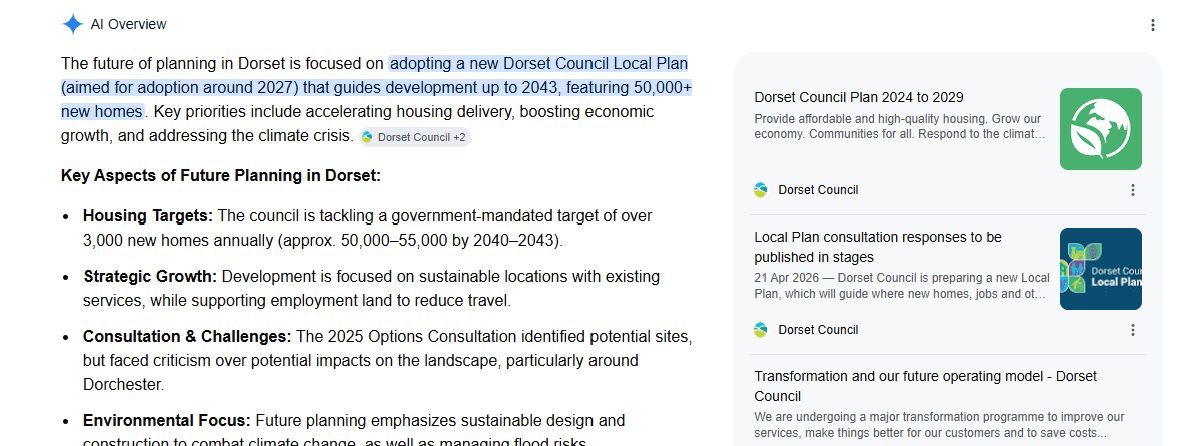
Google now pulls quotes from Reddit and forums directly into AI Overviews. Here is what changed in May 2026, what it means for your visibility, and what to do about it.
Search just changed in a way that most SEO guides have not caught up with yet. Google's AI Overviews are now pulling quotes directly from Reddit, public forums, and social platforms and placing them inside the AI-generated answer at the top of the page. This happened on 6 May 2026. The day after, Google quietly removed FAQ rich results from Search entirely.
These two things happened within 24 hours of each other. Most coverage treated them as separate stories. They are not. Together, they signal a clear shift in what Google considers a trustworthy, useful source.
This post explains what actually changed, what it means for your visibility, and what practical steps you can take in the next 30 days.
What Google actually announced
On 6 May 2026, Google's VP of Search, Hema Budaraju, published a blog post announcing five updates to how AI Mode and AI Overviews work. The relevant one is this.
AI responses will now include a section called "Expert Advice" or "Community Perspectives" (the label varies depending on the query) that pulls perspectives directly from public online discussions, social media platforms, and forums including Reddit. Each entry shows the creator's name, handle, or community name so users can judge whether to click through.
Google's reasoning, stated directly in the announcement, is that "for many searches, people are increasingly seeking out advice from others." The company is responding to a behaviour that users already had. Adding "Reddit" to the end of a Google search became common precisely because AI-generated summaries and polished content articles often lack the kind of real-world experience that people actually want.
Google is now building that behaviour into the product itself.
There is one more thing worth noting. On 7 May 2026, the day after this announcement, Google confirmed that FAQ rich results are no longer appearing in Search. The feature has been removed entirely. It is not a restriction or a rollback. It is gone. Reporting in Search Console disappears in June 2026 and API support follows in August 2026.
The timing is not coincidental. Google is moving away from structured page features that SEO teams gamed and towards surfacing genuine human voices. FAQ schema as a SERP feature is one casualty of that shift.
AI Overviews vs AI Mode: where the community quotes show up
It helps to be clear about what these two things are, because they work differently.
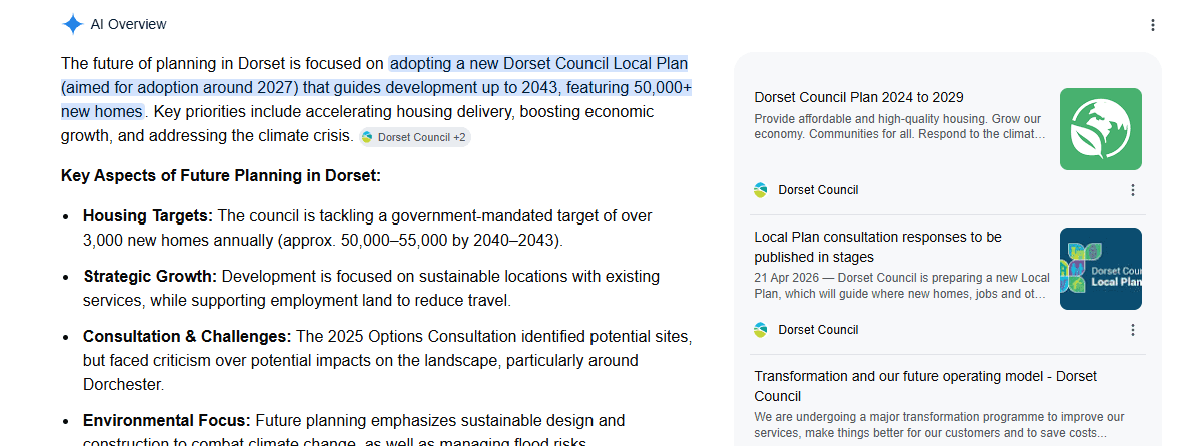
AI Overviews are the AI-generated summaries that appear at the top of standard Google search results pages. They have been rolling out since 2024 and most UK users will have seen them. They summarise an answer and link to sources. The new "Expert Advice" and "Community Perspectives" sections can now appear inside these overviews for relevant queries.
AI Mode is a separate, opt-in experience that replaces the traditional results page entirely with a conversational AI interface. It launched in the US in 2025 and is in limited rollout internationally. AI Mode leans more heavily on community and first-hand sources because the queries it handles tend to be more exploratory and subjective.
Not every search triggers the community quote section. Based on current behaviour, it appears most often for queries where someone is seeking advice, recommendations, or lived experience rather than a factual definition. Questions like "which accountant is best for a small business in Dorset" or "is it worth using AI for content writing" are more likely to surface forum perspectives than a search for "what is corporation tax."
If your business serves people who search for advice and recommendations, this update affects you directly.
The new visibility map: rankings, citations, and quoted sources
For most of the last decade, SEO visibility has been measured in one of two ways. You either ranked in the top ten blue links, or you did not. AI Overviews added a third layer, being cited as a source in the AI-generated answer even if you did not rank first in the traditional results.
The May 2026 update adds a fourth layer. You can now be quoted as a community voice.
Here is how the map now looks.
Traditional organic rankings still matter. The top ten links appear below AI Overviews and still receive clicks, particularly for queries where people want to go deeper than the AI answer.
AI Overview citations appear as linked sources inside the AI-generated summary. Getting cited here requires that your content is clear, factual, well-structured, and trusted enough for Google's model to draw from it. This is what people mean by Generative Engine Optimisation, or GEO.
Community quotes now appear as a distinct section within the AI Overview. These are pulled from forums, Reddit, social platforms, and blogs written by people with first-hand experience. They are attributed to individual accounts or communities.
Further Exploration links are a new addition announced alongside the community quotes feature. Google is now adding recommended in-depth articles at the end of AI responses for people who want to go deeper. This is a potential traffic source for well-structured long-form content.
The practical implication is that your brand can now appear in search results through multiple routes that have nothing to do with traditional keyword rankings.
Risks: misrepresentation, reputation leakage, and context collapse
This update creates genuine risks that are worth understanding before you plan any response.
Misrepresentation. Google's AI model decides which community quotes to surface and what context to display around them. A forum post you wrote three years ago about a problem you no longer have could appear as a current perspective on your business or sector. A complaint about a competitor could be surfaced without the context that makes it fair. An old question you asked in a forum, when you were less experienced, could appear alongside your name.
You have no direct control over which posts are selected. You cannot opt out of a specific quote being used. What you can do is be aware of what you have published publicly and think about whether your current online presence accurately represents your current position.
Reputation leakage. If your business or your sector is discussed negatively in forums, those discussions can now surface directly inside Google's answer to a related query. A thread complaining about slow response times from agencies like yours, or a Reddit discussion about bad experiences with a type of product you sell, could appear inside an AI Overview for a query your potential customers are making.
This is not new in theory. Negative reviews have always existed. What is new is that AI Overviews give them a structured, prominent position at the top of the results page.
Context collapse. Forum posts are written for a specific audience in a specific moment. A response that made sense in a specialist community thread may land very differently when pulled out and displayed to a general audience searching for something broadly related. Sarcasm, nuance, and professional shorthand do not survive context collapse well.
Be thoughtful about what you publish in public forums, not because you should be less honest, but because the audience for those posts is no longer just the community you were writing for.
What to change on your website
The shift towards community voices and cited sources changes what your website needs to do well. Here is where to focus.
Make your expertise legible.
Google needs to understand who you are, what you know, and why that knowledge is credible. This means having clear author pages with real biographical information, not just a name. It means using structured data such as Person schema and Organisation schema to describe your business and the people in it. It means writing in a way that demonstrates experience, not just knowledge. The difference is important. Knowing that social proof matters is knowledge. Explaining what you changed on a client's site and what happened to their enquiry rate as a result is experience.
Write for people who want to go deeper.
The new "Further Exploration" links at the end of AI responses are a traffic opportunity for content that goes beyond the summary level. If your content answers a question thoroughly and is structured clearly, Google is more likely to recommend it as a deeper resource. This means long-form guides, case studies, and practical walk-throughs written with a genuine audience in mind, not keyword-stuffed articles that repeat the same point eight times.
Build content around specific, answerable questions.
Community forums surface because they give direct, experience-based answers to real questions. Your website content should do the same. If a potential client might ask "how long does an SEO campaign take to show results," your site should answer that question directly and honestly, including the conditions that affect the timeline. Generic answers that hedge everything are less useful to users and less likely to be cited.
Tighten your entity signals.
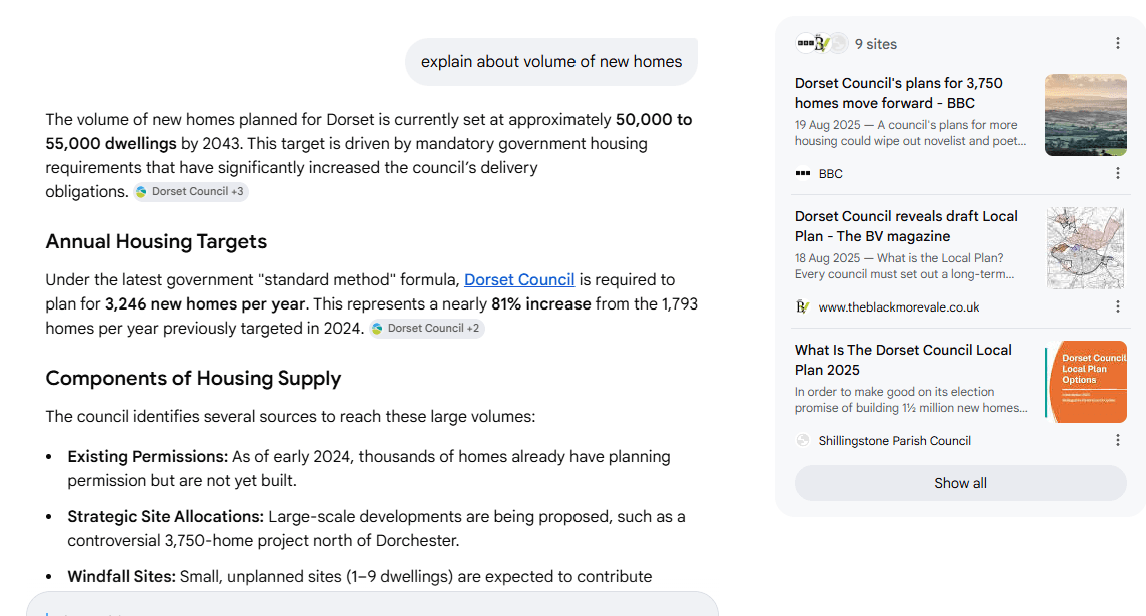
Entity clarity is the idea that Google understands your business as a real, distinct thing with known attributes. This includes your name, location, services, the people who work there, and the clients you serve. Consistent information across your site, your Google Business Profile, and credible external sources (directories, mentions in press, association listings) builds the signal that tells Google you are a legitimate, established entity. This matters more now because AI models use entity understanding to decide whether a source is worth citing.
Do not rush to remove FAQ schema.
Google has confirmed that FAQPage structured data does not cause problems and does not need to be removed. The rich result feature has been removed. The schema itself still helps machines understand the relationship between questions and answers on your page. Other AI search tools, including Bing's index which powers ChatGPT search, still parse it. Remove it if you want to tidy your codebase. Do not remove it because you think it is hurting you. It is not.
What to change off your website
Community presence has always mattered for credibility. It matters more now that Google is actively pulling from it.
Be genuinely present in relevant communities.
This does not mean joining every forum and dropping links to your website. It means contributing honestly to conversations where you have relevant knowledge. If you work in SEO and there is a thread on a UK business forum about whether Google rankings still matter, and you have a considered view, share it. Write it as you would write it if no algorithm ever saw it. The value you provide to the community is what makes the contribution worth surfacing.
Do not manufacture community presence.
Joining forums with the intention of getting quoted in AI Overviews, writing comments that are SEO-adjacent rather than genuinely helpful, or creating fake personas are all bad ideas. This is true for practical reasons (Google is reasonably good at detecting shallow engagement) and for straightforward integrity reasons. Community trust is slow to build and fast to lose.
Consider where your potential clients actually talk.
For B2B businesses targeting SMEs, this might be local business Facebook groups, LinkedIn, or sector-specific forums. For consumer businesses, it might be Reddit communities related to your industry. For local service businesses, it is often nothing more specific than Google reviews and local community pages. You do not need to be everywhere. You need to be present and genuinely useful in the places your potential clients already are.
Protect your Google Business Profile.
Reviews on your Google Business Profile feed directly into local search and increasingly into AI Overviews for local queries. Encourage genuine reviews from real clients. Respond to every review, including negative ones, calmly and professionally. Your response to a negative review is often more visible than the review itself, and how you handle it tells potential clients a great deal about how you operate.
Get credited in credible third-party sources.
Being cited in a local press article, a Chamber of Commerce directory, a trade body member listing, or a sector publication is still valuable. These are the kinds of sources that establish your business as a real entity and that AI models draw on when deciding whether to cite or recommend you.
A 30-day measurement plan
The most important thing you can do right now is establish a baseline before you make changes. You cannot measure the impact of what you do if you do not know where you started.
Week 1: Establish your baseline
Run a set of queries that your potential clients are likely to make. Do this in an incognito browser so the results are not personalised. Note which AI Overviews appear, what sources they cite, and whether any community quote sections appear. Screenshot the results. Do this for 10 to 20 queries that represent the kind of searches that should lead someone to your business.
Check Google Search Console for your current click-through rate on pages that previously had FAQ rich results. Export this data before June 2026 when reporting is removed.
Note whether your business name, or any of your team members, appear in any community quote sections. Search your business name alongside common questions in your sector.
Week 2: On-site changes
Review your most important service pages and ask whether they answer a specific question directly, include clear evidence of experience (examples, outcomes, genuine specifics), and are written by or attributed to a named person with a real author page. Make improvements where the answer to any of those questions is no.
Check that your Organisation schema and any Person schema on your site is accurate and complete. If you do not have author schema, add it to any content pages that are attributed to a specific person.
Week 3: Off-site presence review
Audit where your business appears online outside your own website. This includes your Google Business Profile, Companies House listing, any directory or association listings, and any press mentions. Check for inconsistencies in how your business name, address, and description are presented. Correct anything that is wrong or out of date.
Identify two or three communities where your potential clients are active. Spend time reading, not posting. Understand what questions people are asking and what kinds of responses get engagement.
Week 4: Test and track
Make one or two genuine contributions in the communities you identified. Write them as you would write an email to a knowledgeable colleague who asked for your view. Do not include links unless they are directly relevant and you have been an active member of the community long enough for a link to be contextually appropriate.
Re-run your baseline queries from Week 1. Note any changes. Have any new sources appeared in the community quote sections? Has your content appeared as a "Further Exploration" link? Update your screenshots.
Set a monthly reminder to repeat this cycle. AI Overviews are changing quickly. The sources that get cited, and the queries that trigger community sections, will shift over time. Monitoring regularly is more valuable than a single audit.
What this means in plain terms
Google is trying to make AI search feel less like a machine and more like getting advice from someone who has actually done the thing. To do that, it is pulling in real human voices from forums and communities and placing them inside the AI answer.
This is good for users in many cases. It is a meaningful change for anyone who relies on search traffic.
Your website content, your community presence, and your reputation online now all contribute to where and whether you appear in AI search results. Rankings still matter. But they are no longer the whole picture.
The businesses that will do well in this environment are the ones that are genuinely useful, genuinely present, and genuinely honest about what they know. That is not a new idea. It is just more visible now.
Okapi & Co is an AI-first SEO agency based in Shaftesbury, Dorset. We help UK businesses get found in Google and AI search. If you want to understand how these changes affect your specific situation, get in touch.
Tagged: News, Guide.

Jim Chetwode
Founder, Okapi & Co · Shaftesbury, Dorset
Thirty years in digital marketing, now spent on how businesses get found in Google and cited by AI assistants. Chairman of the Shaftesbury and District Chamber of Commerce, Dorset Ambassador, and the person who runs the AI workshops.