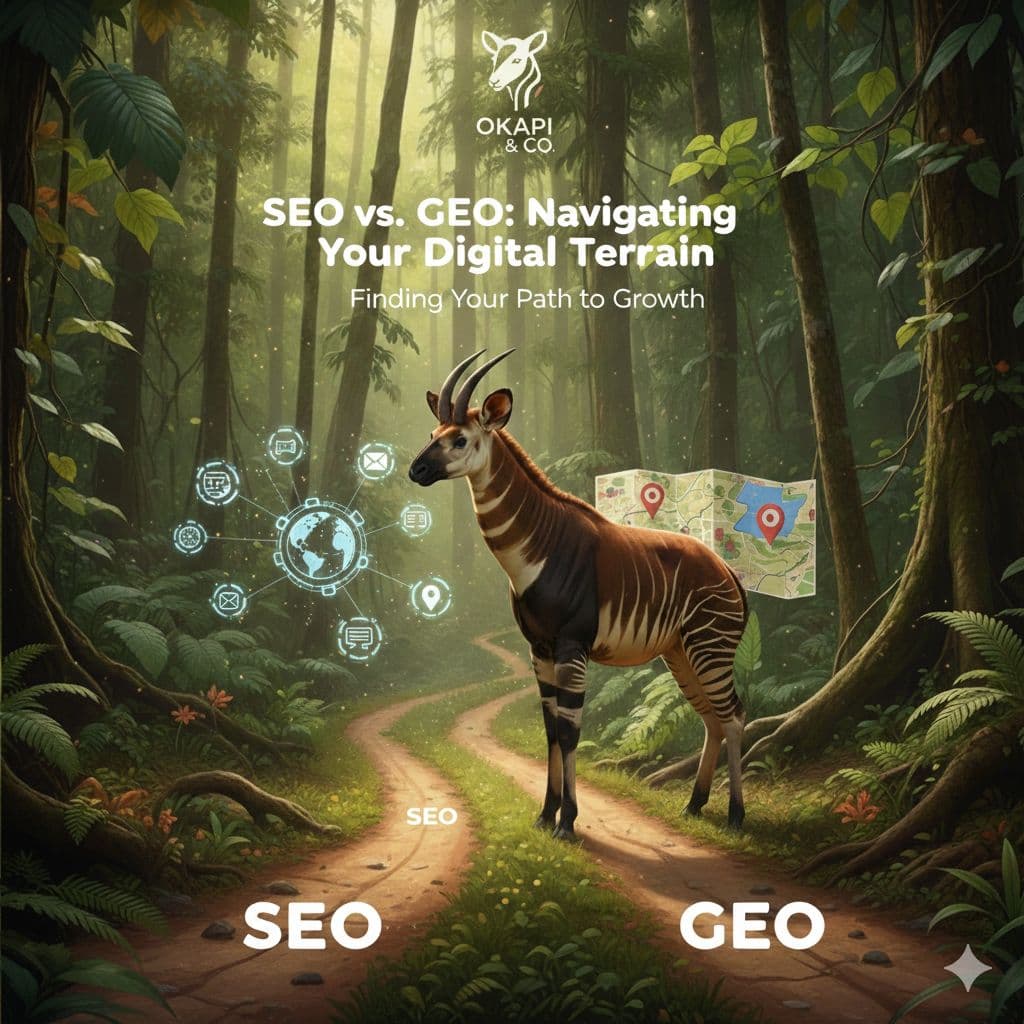
SEO gets you into a list of search results. GEO gets you named in the answer. Learn why your business needs both and what happens if you only focus on one.
If you have been investing in SEO for your business, that is a good thing. It means you understand that being visible online matters. You have probably spent time and money getting your website to appear on Google when people search for what you do.
So when someone tells you there is now something called GEO that you also need to think about, it is perfectly reasonable to ask a simple question.
Is this not just the same thing with a different name?
It is not. And the difference matters more than most business owners realise.
What SEO actually does for you
Search Engine Optimisation has been the foundation of online visibility for over twenty years. When it works well, your website appears in Google's results when someone searches for something relevant to your business.
The system works like a library index. Google crawls your website, understands what it is about, and files it away. When someone searches for something that matches, Google presents a list of results. If your SEO is good, you appear on that list. If it is very good, you appear near the top.
This still matters. Google processes around 13.7 billion searches every day. It remains the single biggest source of website traffic in the world.
But here is what has changed. The way people find answers is no longer limited to scrolling through a list of ten blue links.
What GEO does differently
Generative Engine Optimisation is about making sure your business is visible in AI-generated answers. When someone asks ChatGPT, Google's Gemini, or Perplexity a question, the AI does not show a list of websites. It gives an answer. And within that answer, it may name specific businesses.
This is a fundamentally different process.
With SEO, you are trying to appear in a list. The person then decides which link to click.
With GEO, you are trying to be named in the answer itself. The AI has already decided you are worth mentioning. That is a recommendation, not just a listing.
Think of it this way. SEO is like getting your business into the Yellow Pages. GEO is like getting a trusted friend to recommend you by name when someone asks for advice. If you are new to GEO entirely, our guide to understanding generative engine optimisation explains the basics in plain English.
A simple test you can do right now
Open Google and search for something like "best accountant in Dorset" or whatever is relevant to your business.
You will see a list of results. Maybe some ads at the top. Maybe a map with local businesses. This is what SEO influences.
Now open ChatGPT or Perplexity and ask the same question.
The response will be completely different. You will get a conversational answer that names specific businesses and explains why they are worth considering. There is no list of ten options. There are usually three or four names, sometimes fewer.
If your business is not one of those names, you are invisible in that conversation. And you would never know, because there is no ranking position to check and no analytics report to flag it.
The numbers behind the shift
This is not a niche trend. The scale of AI search usage is now significant enough that ignoring it carries real commercial risk.
ChatGPT alone processes roughly 2.5 billion prompts every day. Google's Gemini app has passed 750 million monthly active users. Perplexity continues to grow rapidly. And Google's own AI Overviews now appear in a substantial percentage of search results, providing AI-generated summaries before the traditional links.
Research from Ahrefs found that ChatGPT now handles roughly 12 percent of Google's search volume for queries that would traditionally have been typed into Google. It has already surpassed Bing.
But here is the critical part. Google sends 190 times more traffic to websites than ChatGPT does. That is because when someone asks ChatGPT a question, they get the answer right there in the chat. They do not need to click through to a website.
This means the old way of measuring success, clicks and website visits, does not capture what is happening. Your business might be getting recommended to thousands of people through AI tools and you would have no way of knowing unless you are specifically tracking it.
Where SEO and GEO overlap
The good news is that the two are not completely separate disciplines. Good SEO foundations help with GEO. If your website is well structured, loads quickly, has clear and accurate content, uses proper schema markup, and has strong authority signals, those things all help AI systems trust and reference your content.
This is why abandoning SEO in favour of GEO would be a mistake. Traditional search is not going away. Google is still enormous and still the primary way most people start looking for information. Your SEO work continues to have value.
But SEO alone is no longer enough. And the gap between what SEO covers and what GEO requires is where most businesses are falling behind.
Where they differ
AI systems evaluate content differently from traditional search engines. Understanding these differences is what separates businesses that appear in AI answers from those that do not.
Traditional SEO rewards keywords. You research what people are searching for, you include those terms in your content, and Google matches queries to pages. Keywords still matter, but they are not the primary factor in whether an AI tool mentions your business.
GEO rewards topic depth and clarity. AI systems are looking for content that thoroughly and clearly addresses a subject. They want to pull out specific, useful information they can include in an answer. Vague marketing copy does not give them anything to work with.
SEO focuses on ranking position. Success means appearing as high as possible in a list of results. Position one gets the most clicks. Position ten gets very few.
GEO focuses on being cited. There is no ranking system in an AI response. You are either mentioned or you are not. And interesting research has shown that 90 percent of the pages ChatGPT cites are not even in Google's top 20 results for the same query. Being good at SEO does not automatically make you visible to AI.
SEO depends heavily on backlinks. The number and quality of websites linking to yours has been a core ranking factor for years.
GEO depends more on brand mentions. Research has found that branded web mentions have a much stronger correlation with appearing in Google's AI Overviews than backlinks do. It is not just about who links to you. It is about who talks about you.
SEO content can be optimised after publication. You can update a page, change its title, add keywords, and watch it climb the rankings over weeks or months.
GEO rewards consistent authority over time. AI systems build an understanding of which sources are trustworthy on which topics. Once they identify your business as a reliable source, they tend to keep referencing you. But building that trust takes consistent, quality content across multiple platforms, not just your own website.
What this means for your business in practical terms
If you are a local business, the implications are particularly important.
Someone searching Google for "plumber near me" sees a map and a list. That is SEO territory and it still works well.
But someone asking ChatGPT "can you recommend a reliable plumber in Shaftesbury" gets a direct answer with specific names. That is GEO territory. And the businesses being named there are not necessarily the ones ranking highest on Google. They are the ones with clear, detailed content about their services, consistent information across directories and platforms, genuine customer reviews, and a digital presence that AI systems can easily understand and trust.
The businesses that win are the ones doing both.
Why most agencies only do half the job
Here is an honest observation. Most SEO agencies in the UK are still focused entirely on traditional search. They track rankings, build backlinks, optimise meta descriptions, and report on organic traffic. That work is still valuable.
But very few are actively monitoring whether their clients appear in AI-generated answers. Fewer still have the tools or the knowledge to influence those results.
This is not a criticism. The field is moving quickly and GEO as a discipline is still relatively new. But it does mean that if your current agency is not talking to you about AI visibility, there is a significant part of your online presence that nobody is managing.
What we do at Okapi and Co
We handle both SEO and GEO because we believe they work best together.
On the SEO side, we do the technical work that keeps your website healthy and visible in traditional search. Proper site structure. Fast loading times. Clean code. Schema markup. Content that matches what people are actually searching for.
On the GEO side, we monitor how your business appears across ChatGPT, Gemini, Perplexity, and Google's AI Overviews. We analyse what your competitors are doing differently. We create content that AI systems can understand, trust, and reference. We build your presence across the platforms and directories that AI tools use as sources.
We also built our own diagnostic tools that check your AI search visibility across multiple platforms. If you want to see where you currently stand, we can run a free assessment that shows exactly which AI tools are recommending you, which are recommending your competitors, and where the gaps are.
The window is still open
One thing that comes through clearly in the data is that GEO is still in its early stages. Most businesses have not started thinking about it yet. Most agencies are not offering it.
That means the businesses that move now have a genuine advantage. AI systems tend to reinforce their own recommendations over time. Once they identify your business as a trusted source on a topic, they are more likely to keep referencing you. The longer you wait, the harder it becomes to displace the businesses that got there first.
This is not a scare tactic. It is simply how these systems work. Early movers build compounding authority.
What to do next
If you are already doing SEO, do not stop. It is still important and it still delivers results.
But ask yourself this. When someone asks an AI tool to recommend a business like yours, does your name come up? If you do not know the answer, that is the first problem to solve.
We can help you find out. Visit okapiandco.co.uk/contact and we will run a free AI visibility check for your business. No obligation, no pressure. Just a clear picture of where you stand in both traditional search and AI search, and an honest conversation about what would make the biggest difference.
Okapi and Co is a digital marketing agency in Dorset specialising in SEO and Generative Engine Optimisation. We help businesses get found in both traditional search engines and AI-powered tools like ChatGPT, Perplexity, and Gemini.
FAQ Schema Content (to be moved to FAQ Schema field once created)
Q: What is the difference between SEO and GEO?
A: SEO focuses on ranking your website in traditional search engine results like Google. GEO focuses on getting your business mentioned and cited in AI-generated answers from tools like ChatGPT, Gemini, and Perplexity. SEO gets you into a list. GEO gets you named in the answer.
Q: Do I still need SEO if I invest in GEO?
A: Yes. Google still processes around 13.7 billion searches every day and remains the biggest source of website traffic. SEO and GEO work best together because good SEO foundations like structured data, clear content, and site speed also support GEO performance.
Q: How do I check if my business appears in AI search results?
A: Open ChatGPT, Gemini, or Perplexity and ask them to recommend a business like yours in your area. If your business is not named in the response, you are currently invisible to AI search. Okapi and Co offers a free diagnostic tool that checks your visibility across multiple AI platforms.
Q: Why does my business rank well on Google but not appear in ChatGPT?
A: AI tools use different signals to decide which businesses to mention. Research shows that 90 percent of pages cited by ChatGPT are not in Google's top 20 results. AI systems place more weight on brand mentions, topic depth, structured data, and consistent information across platforms rather than traditional ranking factors like backlinks alone.
Q: Is GEO just a trend or does it matter long term?
A: AI search usage is growing rapidly and shows no signs of slowing. ChatGPT processes roughly 2.5 billion prompts daily and Google's AI Overviews now appear in a significant percentage of searches. The businesses building AI visibility now are establishing compounding advantages that will be harder for competitors to overcome later.
Internal Linking Suggestions
- Link to "How to check if your business is invisible to AI search" post
- Link to "How to get found in your area by AI and search engines" post
- Link to "What actually happens when you hire us for GEO work" post
- Link to the AI Lab / diagnostic tool page
- Link to the GEO service page
Social Sharing Copy
LinkedIn: You are already doing SEO. But when someone asks ChatGPT to recommend a business like yours, does your name come up? SEO gets you into a list. GEO gets you named in the answer. Here is why you need both.
Facebook/Instagram: Still relying on Google rankings alone? AI tools like ChatGPT and Perplexity are now recommending businesses by name. If yours is not one of them, you are missing enquiries you will never know about.
Tagged: Guide, Opinion.

Jim Chetwode
Founder, Okapi & Co · Shaftesbury, Dorset
Thirty years in digital marketing, now spent on how businesses get found in Google and cited by AI assistants. Chairman of the Shaftesbury and District Chamber of Commerce, Dorset Ambassador, and the person who runs the AI workshops.