AI and Claude Training for Teams
Most businesses treat AI as a novelty one person plays with.
- 8 to 12 hours
- a week saved across one business, conservatively
- About £70
- a month in tool costs, all in
- 90 to 25 minutes
- daily customer-service triage, before and after
- 3 hours to 15 minutes
- to build the weekly dashboard
We train your team on Claude and ChatGPT and build it into the way the work gets done, with a policy behind it and a shared way of working. The results without the hype.
Everyone has tried ChatGPT. Almost nobody has rolled it out properly.
Most business owners have had the AI pitch and tried a few chats. A smaller number pay for a subscription. Almost none have rolled it out across the business in a way that actually changes how the work gets done.
That is a shame, because the businesses that get it right are quietly pulling ahead. Not because the AI is doing anything magical, but because they have taken the mundane, repetitive parts of the work and pushed them off the people who used to do them.
A training day, then about three weeks of implementation
We do not hand you a login and wish you luck. We train your team and build the working system in the same rollout.
- A usage policy first, not last. Before anyone pastes customer data anywhere, we write a one-page AI policy your leadership can sign off in a morning. Five rules that fit on a postcard. It is what lets people move quickly without worrying.
- Shared Projects with your brand baked in. Instead of everyone starting from a blank chat, each team gets its own Project loaded with role-specific instructions and your tone. Every conversation inherits the rules for free.
- Automations that do the boring bit. The repeated manual jobs get pushed off your team. A shared inbox that drafts its own replies from your order data. Research that lands before the sales meeting. Reports that build themselves overnight.
- One shared way of working. The reason most rollouts fail is that AI is treated as one person's tool, not a system the business runs on. We set it up so everyone in a team works the same way, from the same templates. Consistency is what makes it stick.
A UK skincare brand, clawing back a day and a half a week
A direct-to-consumer skincare brand selling on Shopify and to trade through wholesale. Customer service ran through a shared inbox where two people spent the first 90 minutes of every day triaging, then drafting replies one order lookup at a time. The weekly marketing dashboard was built by hand, three hours every Monday. We rolled AI out one team at a time, with a policy behind it.
Numbers reported conservatively. Cold-outreach open rates are up on early data, but we want another 90 days before we quote a firm figure. We would rather under-promise.
AI, answered plainly
Do you train us on ChatGPT or Claude?
Both, and we pick the right tool for each job rather than being loyal to one. In a typical rollout your team works in shared Projects (in ChatGPT or Claude) that carry your brand context, and we use Claude for the automations that draft work in the background. You end up with one shared way of working, not five people each guessing.
What does an AI rollout actually involve?
A training day for your team, then about three weeks of implementation. We start with a one-page AI usage policy so everyone is confident about what is and is not allowed, set up shared Projects with your brand and tone baked in, and build the automations that remove the repeated manual jobs. You are left with a system the business runs on, not a novelty one person plays with.
Is our data safe if the team uses AI?
That is exactly why we start with a written usage policy before anyone pastes anything anywhere. Five plain rules: do not invent facts, do not publish without a human review, do not paste sensitive data, use the right tool for the job, and ask before doing something risky. The policy is not there to slow you down, it is there to let everyone move quickly with confidence.
How much time can we realistically save?
It depends on how much repeated manual work you have, but if you run a shared inbox and build reports by hand, five to ten hours a week is a realistic target. On one recent rollout we saved a business a conservative eight to twelve hours a week, for around £70 a month in tool costs. We will tell you honestly where the savings are before you commit.
Do you only train, or do you build the automations too?
Both. Training on its own rarely sticks, because people go back to their old habits. We train your team and build the automations in the same rollout, so the new way of working is there waiting for them on day one.
Do you work with teams outside Dorset?
Yes. We are based in Shaftesbury, Dorset, but training and rollout work is done in person and remotely with businesses across the UK.
Related reading
- Four things worth knowing before you use AI at work
The four habits that come up at every AI for Business workshop: adding files, picking the right model, talking instead of typing, and not burning your allowance.
- Building a Website with Claude Code: What Our First Training Session Taught Us
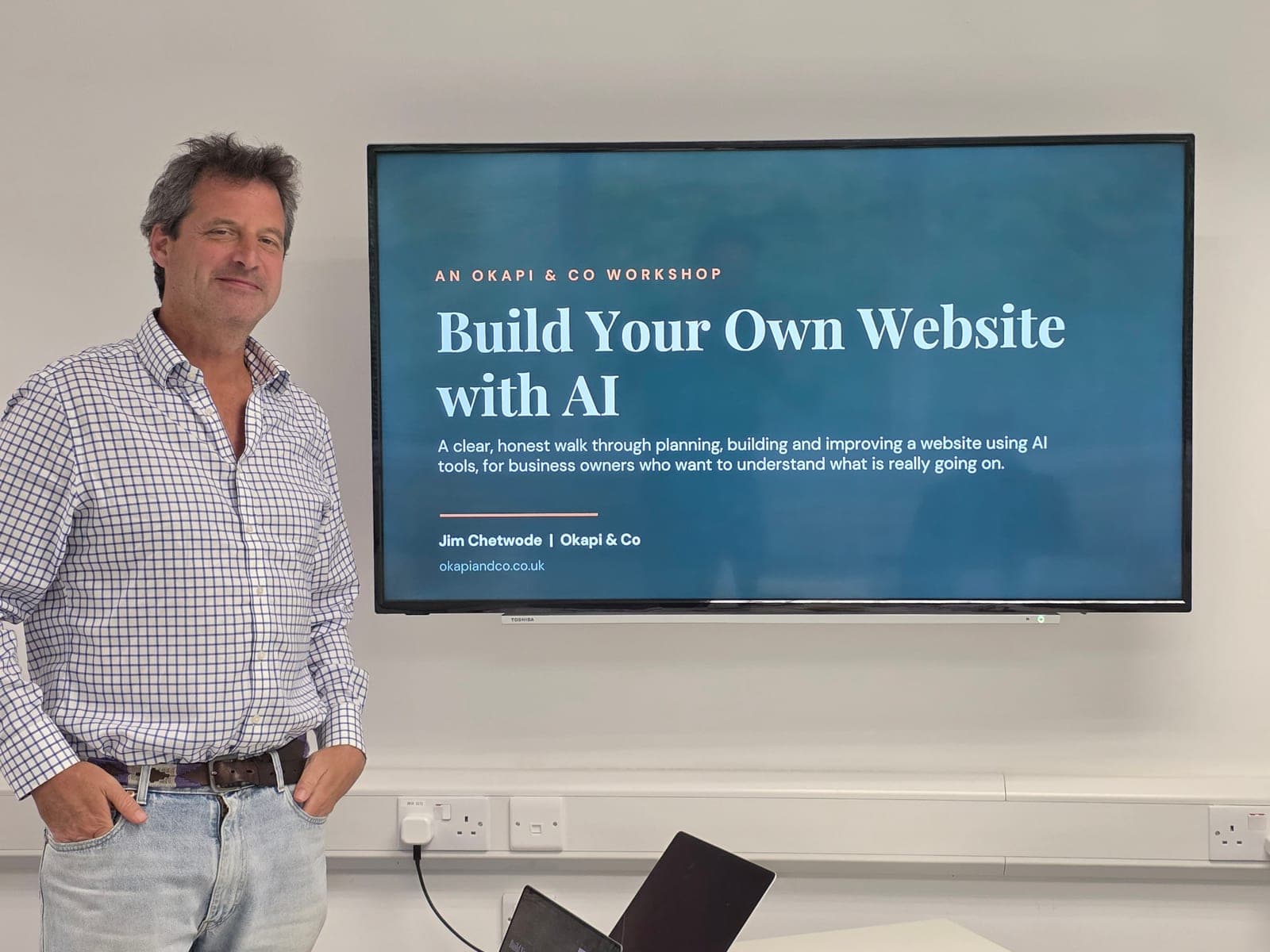
We ran our first Build a Website with Claude Code workshop in Shaftesbury. Here is how it went, the tools we used, and an honest lesson before you try it.
- Why Your Prompt Is the Most Important Thing You Type Into AI
Most people get mediocre results from AI tools not because the technology is bad, but because the prompt is wrong. Here is what a great prompt looks like — and two free tools to help you write one.
Let's talk about your business.
Twenty minutes, no pitch. Tell us what you are stuck on and we will tell you straight whether we can help. Book a free call, or have a look at what we have already built.