AI SEO this week: Google says there is no such thing as AI SEO
By Jim Chetwode · 15 October 2026 · 8 min read
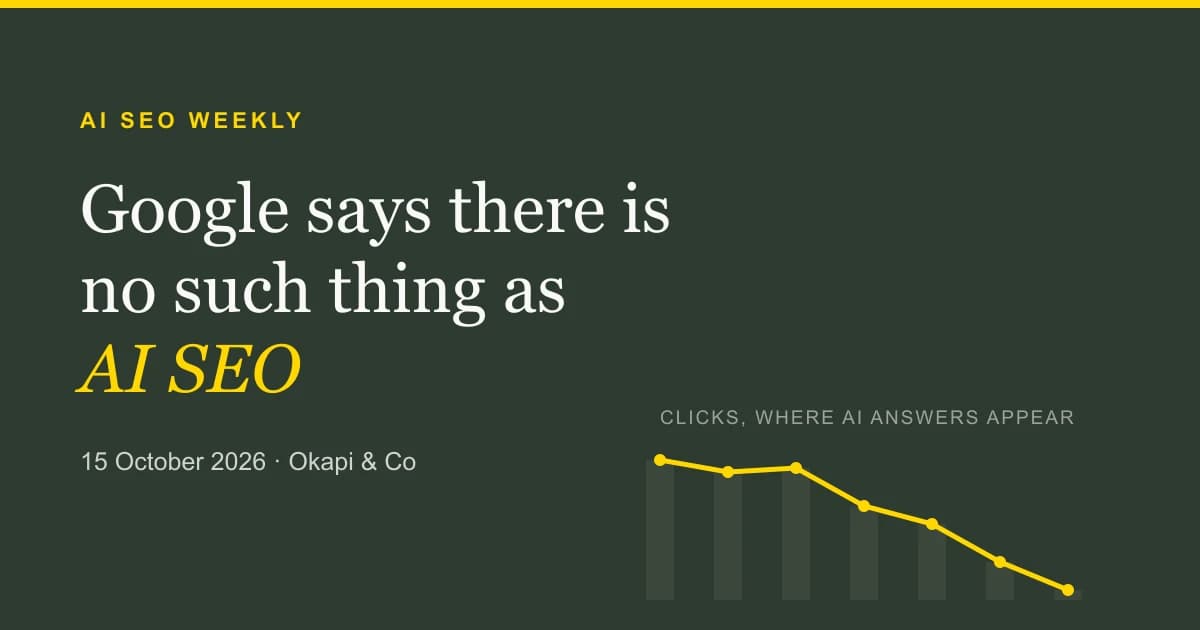
Google has put it in writing. No special files, no AI schema, nothing new required to appear in AI answers. Plus the zero-click figure that matters more than any of it, and three jobs to do this week.
Second instalment. Every week I read the SEO and AI search news so you do not have to, keep the evidence apart from the opinion, and say plainly when something is a vendor's claim rather than a fact.
This week produced the most useful thing Google has published on AI search so far, and it is not a feature. It is a flat statement that AI SEO is not a separate discipline at all. Underneath it sits a number about clicks that matters more to your business than anything else here.
What happened
1. Google says the rules have not changed
Google updated its guidance on how websites turn up in AI Overviews and AI Mode. The list is short and familiar. A search engine can reach the page. The page is indexed. It is linked to from elsewhere on your own site. The important words are visible on the page rather than trapped in an image or loaded by a script. Your structured data matches what a visitor actually sees.
Then the part worth printing out: Google states that there are no special AI files and no AI-specific schema types.
A lot of money is being asked at the moment for AI schema and GEO packages aimed at small businesses. By Google's own description, those sell something that does not exist. If you are being quoted for one, ask the supplier to show you the line in Google's documentation that supports what they are charging for. A good supplier will find it in about a minute. The rest is your answer.
One limit, because I promised to keep these apart. Google is describing Google. ChatGPT, Perplexity and Copilot publish no equivalent guidance and do not all work the same way. "Nothing special is required" is now well evidenced for Google's own surfaces. Everywhere else it is a sensible assumption, not a proven fact.
2. Two thirds of searches now end without a click
A SparkToro study found that 68.01% of US Google searches in the first four months of 2026 ended without a click on anything at all. AI Overviews appeared on more than a fifth of those searches, and where they appeared, click-through was close to 60% lower.
The caveats are real and I am not going to bury them. This is US data. It is one study. It shows AI Overviews and lower clicks happening together rather than proving that one caused the other. The fullest write-up of it is from June rather than this week.
I include it because it is the ground everything else stands on, not because it is news. The old arrangement was that Google showed your page, somebody clicked, and you got a chance to sell to them. That arrangement is weakening.
3. Visual search is now reported too
Search Console has started reporting performance from Google Lens, Circle to Search, photo uploads and Search this image.
If you sell something physical, or something people photograph, a shopfront, a plate of food, a part, a fault on a machine, then your photographs have quietly become a measurable route into your business rather than decoration on a page. Worth a look if that describes you, and safely ignorable if it does not.
4. A localisation finding worth noting and not acting on
OtterlyAI looked at 3.95 million German citations across seven AI search engines and found that 64.9% pointed at a German, Austrian, Swiss or otherwise German-language web address.
Genuinely interesting. It is also one vendor, one language market, and the variation between industries was enormous: 73% for healthcare against 31% for education platforms. If you sell into a non-English market, this is worth a four-week test on one page. If you are a Dorset business serving Dorset, it is not your problem and I will not raise it again.
What this means for a small business
Being the answer matters more than being the top link. The facts that get lifted into an AI answer are the ones stated plainly on your site. What you do, who for, where, what it costs, how long it takes, who it is not for. Vague paragraphs do not get quoted.
What happens away from your website matters more. Reviews, your Google Business Profile, directories, your trade association, local press, video, other people mentioning you by name. AI answers are stitched together from several sources, so being the only place on the internet that says anything about you is a weak position.
People who already know your name are the hedge. Someone who searches for your business by name, or types your address straight in, is untouched by all of this. Everything that builds that kind of demand is worth more than it was a year ago.
The work has not changed, only the reason for doing it. Everything above was good practice before AI answers existed. That is the useful part of Google's statement, and it should save you money rather than cost you any.
Three things to do this week
1. Open the report and write the number down. About 20 minutes
Search Console, Performance, Generative AI tab. Export it and save the file with today's date on it. That is your baseline, and without one you will not be able to tell whether anything you do over the next six months worked.
If you do not have access to Search Console for your own website, that is the actual first job. It is free and whoever built your site can sort it in an afternoon.
2. Run your 20 questions again. About 30 minutes
If you wrote your list after last week's round-up, this is the week you find out whether anything moved. Same questions, same engines, and write down who gets named now.
If you have not written them yet, that is this week's job instead. Ten about your business by name, ten about your category. Ask ChatGPT and Google's AI Mode each one. Record the answer, the date, and which websites got cited. It costs nothing, it needs no software, and it will tell you more in half an hour than most paid tools will tell you in a quarter.
3. Check your details agree everywhere. About 45 minutes
Business name, address, phone number, opening hours and the services you list, across your own website, your Google Business Profile and the main directories you appear in. Where they disagree, you become the unreliable source and the answer about you gets vaguer.
What I would not spend money on this week
AI visibility scores. Before you pay for a tool that gives you a percentage, ask the vendor whether it saves the full answer, the date, the engine it used and the websites it cited. If all you get back is a number, you cannot audit it and neither can I. There is a fair question going round about whether some tools read live answers from the web or partly the model's own stale memory, and a score on its own cannot tell you which.
GEO frameworks promising results in days. There is a post circulating that claims an exact framework produced an international lead within 72 hours. No method, no attribution, no way to check any of it. That is a story, not a finding. I mention it only because somebody may well send it to you.
How much to trust this week's sources
| Claim | Where it comes from | How much to trust it |
|---|---|---|
| No special AI files or schema types are needed | Google Search Central documentation | High. Google documenting its own products. |
| AI performance reporting is live in Search Console worldwide | Google Search Central announcement | High. Same. |
| Visual search is now reported too | Google Search Central announcement | High. Same. |
| 68.01% of US searches ended without a click | SparkToro, reported by Search Engine Land | Medium. One study, US only, association rather than proven cause, fullest write-up from June. |
| 64.9% of German AI citations used a local address | OtterlyAI, German AI Search Index 2026 | Medium. Large dataset, but one vendor, one language market, and huge variation by industry. |
| AI visibility tools may mix live and stale answers | Practitioner discussion | Low as evidence. High as a question worth putting to a vendor. |
| A GEO framework produced a lead in 72 hours | Anonymous forum post | None. No method, no attribution. |
Two terms worth knowing
Zero-click search. A search that gets answered on the results page itself, so nobody visits a website at all. The 68% figure above is the share of searches that ended this way.
Query fan-out. When an AI breaks one complicated question into several smaller searches before assembling its answer. It is why a single page rarely wins an answer on its own, and why what other sites say about you matters.
Frequently asked questions
If there is no such thing as AI SEO, why is everyone selling it?
Because the name is new and the anxiety is real. The work underneath is ordinary SEO plus a bit more care about being quotable and consistent. That is worth paying for. A separate product with its own schema and its own files is not, because Google says it does not exist.
Should I cancel my AI visibility tool?
Not automatically. Ask it one question first: can it show you the full answer, the date, the engine and the cited links behind its score? If it can, it is doing something you cannot easily do by hand at scale. If it only gives you a number, you are paying for a chart.
Does the 68% figure apply to the UK?
Not directly. It is US data and nobody should present it as a British number. The direction of travel is almost certainly the same here, but if you want a figure for your own business, your Search Console impressions and clicks are the honest version.
Do I need to do anything about the German localisation study?
Only if you sell into a non-English market. For a UK business serving UK customers it changes nothing this week.
Want a second pair of eyes on your AI visibility? I run a fixed-price AI SEO audit from £495 that covers the Search Console report, your schema and the 20 questions above. If you would rather learn to do it yourself, the AI and SEO workshops in Dorset cover exactly this. Next week's round-up lands in the newsletter first.
Tagged: AI SEO Weekly, AI SEO, Generative engine optimisation, GEO, Search Console, AI visibility, Zero-click search, AI Overviews.

Jim Chetwode
Founder, Okapi & Co · Shaftesbury, Dorset
Thirty years in digital marketing, now spent on how businesses get found in Google and cited by AI assistants. Chairman of the Shaftesbury and District Chamber of Commerce, Dorset Ambassador, and the person who runs the AI workshops.