
Getting mentioned in AI answers, and what nobody can promise you
By Jim Chetwode · 20 September 2026 · 8 min read
The industry has moved from asking what GEO is to selling scores for it. Here is what actually decides whether AI answers mention your business, in plain English.
This is our weekly note on AI search, written for people running a business rather than for people running an SEO department.
This week the industry chatter has changed shape. For about a year the question was "what is GEO", meaning generative engine optimisation, the business of getting named in AI answers. Now the question is "how do I get mentioned", and a lot of people are selling answers to it. Scores. Dashboards. AI visibility ratings out of 100.
Some of that is useful. A fair amount of it is invented. So this week is less about news and more about what actually decides whether an AI answer mentions your business, what you can measure honestly, and what to do in the next hour or two.
In this note
- The short version
- What people are talking about
- The three gates
- Two different measurements
- Start with being easy to describe
- Make your pages easy to quote
- Reporting it honestly
- Four things worth doing this week
- The jargon, translated
- Where this comes from
The short version
- There is no secret AI file, tag or score. Google's own documentation says there are "no additional requirements to appear in AI Overviews or AI Mode".
- What does matter is being reachable, being easy to describe, and having your claims backed up somewhere other than your own website.
- Rankings and AI mentions are two different measurements. Keep them apart in your reporting or you will end up comparing the wrong numbers.
- The businesses getting mentioned tend to publish something nobody else can: their own numbers, their own tests, their own experience.
- Anyone selling you a guaranteed AI visibility score is selling you a guess with a number on it.
What people are talking about
Five themes came up repeatedly this week, across SEO publications, conference talks and the usual online arguments.
GEO has turned into checklists. A year of theory has become a pile of practical guides about winning mentions. Most of the advice is sensible. Almost none of it is new, because it is mostly the SEO fundamentals with different words on top.
Visibility without clicks. The awkward one. Your business can be named in an answer, influence a decision, and never show up as a visit in your analytics. Everyone agrees this is happening. Nobody has a tidy way to prove its value yet.
Mentions are being treated like the new rich result. Being referenced, and referenced accurately, is becoming a goal in its own right alongside ranking.
Commodity content is losing. If a page just summarises what is already common knowledge, an AI answer can do that itself and has no reason to send anyone to you. Pages built on your own experience, data or opinion are much harder to absorb and much easier to cite.
Vendors are selling GEO scores. Tools that claim to grade your AI visibility are everywhere. Practitioners are sceptical, and rightly so. A score that does not connect to real enquiries is decoration.
The three gates
Underneath all of the noise, there is a simple sequence. Before an AI answer can mention you, three things have to be true, in order.
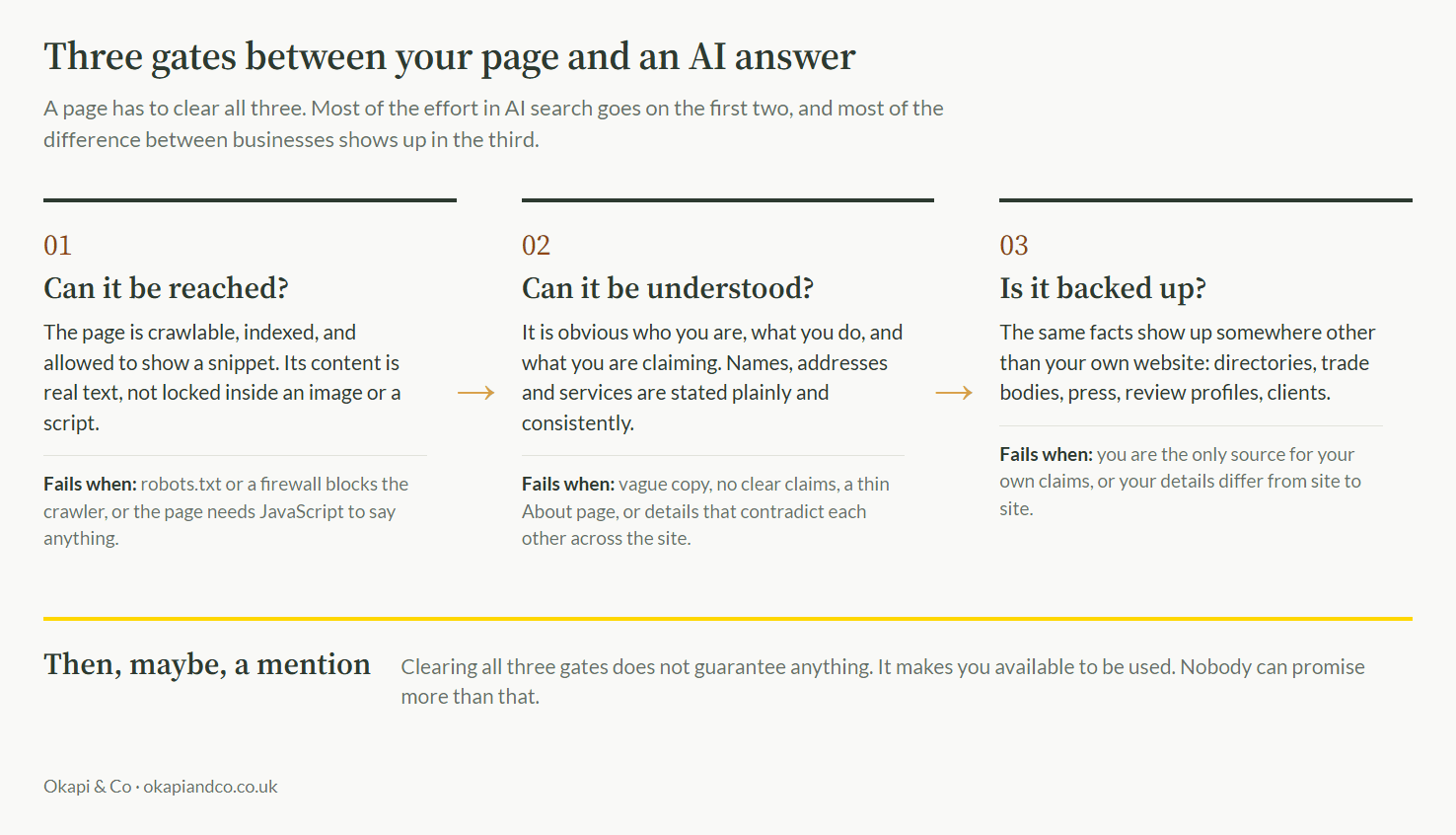
Most businesses that are invisible in AI answers fail at gate one or gate two, and never get as far as the interesting problem. Gate one is a technical check that takes minutes. Gate two is a writing job. Gate three is the one that takes months, which is why it is worth starting now.
Two different measurements
The most common reporting mistake at the moment is blending classic search performance and AI visibility into a single number. They answer different questions and they move for different reasons.
| What you are asking | Classic search | AI search visibility |
|---|---|---|
| The question | Where do we rank, and how many people clicked? | Are we mentioned at all, and described correctly? |
| Where the number comes from | Search Console: clicks, impressions, average position | Asking the AI tools the questions your customers ask, and recording what comes back |
| What good looks like | More clicks, from more different searches | Named in the answers that matter, with the right facts attached |
| What it cannot tell you | Whether anyone mentioned you without a click | How many sales it caused |
| How fast it moves | Weekly | Slowly, then suddenly |
One important detail people get wrong: Google reports AI Overviews and AI Mode inside your ordinary Search Console performance figures, in the Web search type, rather than as a separate AI report. So your Search Console numbers already include some AI activity. They just do not label it.
Start with being easy to describe
If an AI system cannot state clearly who you are and what you do, it will not risk saying it. This is the cheapest thing to fix and the one most small businesses have left half done.
In practice that means your About page does actual work. Not a paragraph about passion. Five to ten specific claims, each with something behind it: the sectors you work in, the towns you cover, how long you have been going, the qualifications, the memberships, the named clients who are happy to be named.
It also means your details match wherever they appear. Same business name, same address format, same phone number, on your site, your Google Business Profile, your trade association listing, your LinkedIn. Contradictions make a system less confident about you, and a system that is unsure tends to stay quiet.
Then add Organization markup, which is a small block of code that states your name, website, logo and social profiles in a format machines read directly. It is not magic and Google is explicit that no special AI markup exists. It just removes any doubt about the basics.
Make your pages easy to quote
Once you can be found and described, the question becomes whether there is anything on your page worth quoting.
The pattern that works is boringly simple. Put a short block near the top of your important pages with two to four plain conclusions and a real number or two. Write it so it could be lifted out and still make sense on its own. That is what "cite-ability" means, and it is the same discipline as writing a good opening paragraph.
Better still, publish something only you have. A table comparing options with a sentence on how you tested them. A before and after from real work. Prices, timescales, failure rates. This week's genuinely useful idea from the industry is a small one: even a twenty-row comparison table with a note explaining your method makes a page far more quotable than another thousand words of description.
We wrote about this in more detail in why AI search rewards specifics, which is the same argument with examples.
Reporting it honestly
If you pay someone for search work, or you do the reporting yourself, split it in two.
Keep classic search reporting as it is. Clicks, impressions, positions, enquiries. Then add a short, separate AI visibility check. Pick ten to fifteen questions a customer might genuinely ask, including your business name, your main service plus your town, and a couple of competitor comparisons. Ask them in ChatGPT, Gemini and Google AI Mode once a month. Write down whether you were mentioned, what was said about you, and which sources were cited instead of you.
That is it. It takes half an hour, it is repeatable, and it is honest about what it is: a sample, not a measurement of the whole internet. Note alongside it what you changed that month, so you can see which work moved the needle.
What nobody should promise is a guaranteed position in an AI answer, a fixed percentage improvement, or a proprietary score that only their tool can see. Those answers are generated fresh each time and vary by person, place and phrasing.
Four things worth doing this week
- Add a "what we are known for" block to your About page: five to ten specific claims, each with proof behind it.
- Check your business details are identical on your website, your Google Business Profile and two other places you are listed.
- Pick your single most important page and add a short summary block at the top, with one real number in it.
- Start a one-page log: fifteen questions, asked monthly, and whether you were mentioned.
If you only do one, do the first. It is the foundation for the other three.
The jargon, translated
GEO, or generative engine optimisation. Trying to get named in AI answers, as opposed to ranking in a list of links. Largely the same work as good SEO, aimed at a different surface.
Cite-ability. How easy your page is to quote. Clear claims, real numbers, a short summary, a method you can describe.
The answer supply chain. The journey from your page being crawled, to being understood, to being chosen for an answer. The three gates above.
Visibility without clicks. Being mentioned in an answer without anyone visiting your site. It still builds recognition, and it still shows up later as someone searching for you by name.
Query fan-out. Google's term for what its AI features do behind the scenes: turning one question into several related searches, then building an answer from the results. It is why being decent across a topic beats being perfect on one page.
Where this comes from
Most of the industry writing about AI search is opinion, including some of this. Where there is documentation, it is worth reading it yourself rather than taking anyone's word for it, ours included.
- AI features and your website, Google Search Central. The primary source for what is and is not required, and for how AI features are reported.
- Creating helpful, reliable, people-first content, Google Search Central. The standard the AI features fall back on.
- Organization structured data, Google Search Central. What to put in your markup, and the properties that matter.
- sameAs, schema.org. The property that links your business to your profiles elsewhere.
- Search Console performance report, Google. Where your AI Overviews and AI Mode activity is already being counted.
- AI Overviews now answer in full, our note from a fortnight ago on what changed in Google's answers.
Tagged: AI Search, GEO, SEO, Google.

Jim Chetwode
Founder, Okapi & Co · Shaftesbury, Dorset
Thirty years in digital marketing, now spent on how businesses get found in Google and cited by AI assistants. Chairman of the Shaftesbury and District Chamber of Commerce, Dorset Ambassador, and the person who runs the AI workshops.