
Google AI Mode vs ChatGPT: How to Measure What Each Channel Is Worth
By Jim Chetwode · 3 November 2026 · 5 min read
A click from an AI search tool is not automatically worth the same as a click from Google, and a cheap visit is not necessarily a profitable one. Here is what the latest announcements and research actually say, where the gaps are, and a 30-day plan for finding out which channel earns its place in your business.
A click from an AI search tool is not automatically worth the same as a click from Google. A cheap visit is not necessarily a profitable one either.
As Google expands advertising in AI Mode and businesses experiment with ChatGPT, the sensible question is not which platform has the most exciting headline. It is which activity brings the right customers to your business at a cost you can afford.
Here is what the latest announcements and research tell us, where the gaps are, and how to run a useful comparison without pretending the channels are identical.
What is changing in Google AI Mode?
Google's AI Mode lets people ask more conversational questions and follow up within the same search experience. On 28 October 2026, Google announced that ads in AI Mode were expanding to ten additional countries, with the UK among the markets planned for the fourth quarter of 2026. That was a plan, not confirmation that every UK advertiser had access.
Google also announced US ads appearing in follow-up questions, which it calls multiturn ads. This matters because a customer may refine their needs over several questions before deciding which product or service to investigate.
Google said click-through rates for sponsored and organic product list items in AI Mode were similar in its internal US data. That is a platform-reported finding about a particular format and period. It does not tell you whether those clicks were profitable for your business.
This sits on top of a change we wrote about in September, when AI Overviews started answering in full rather than teeing up a click. The paid formats are new. The pressure on the unpaid click is not.
What did the ChatGPT advertising study find?
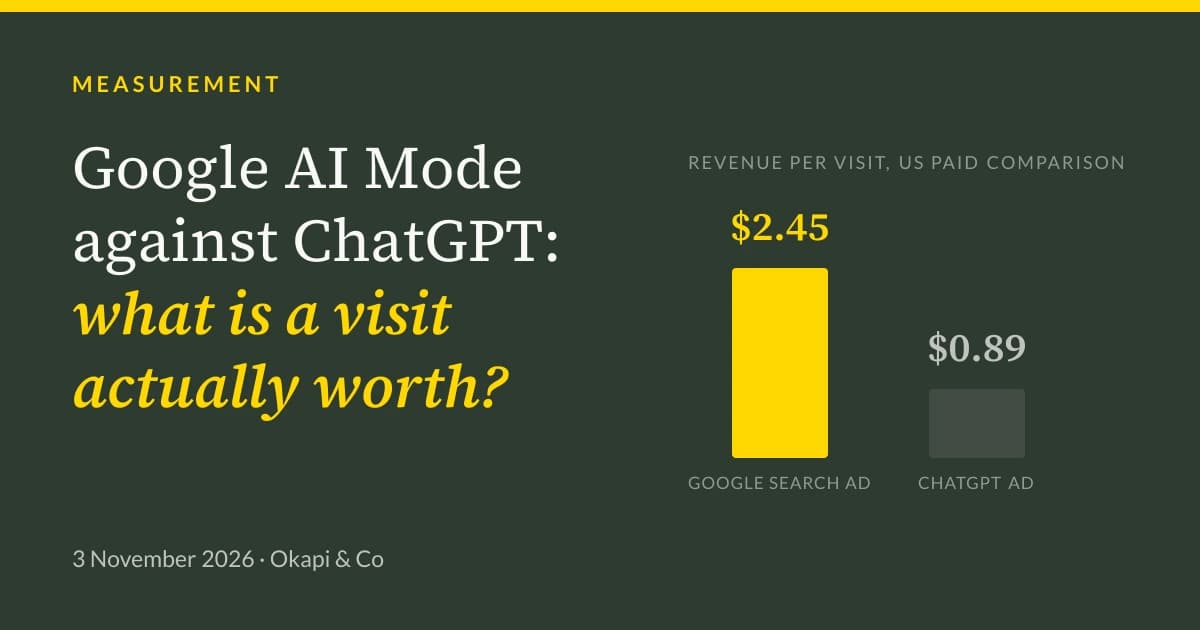
A November 2026 report in Search Engine Land covered a working paper examining visits across nearly 1,900 websites. In the US paid-traffic comparison, researchers found an average of $0.89 revenue per ChatGPT ad visit, compared with $2.45 per Google Search ad visit. Reported conversion rates were 0.37% and 1.17% respectively.
The paid comparison used a smaller sample than the full study. The analysis was observational and attributed revenue to website visits, so it can miss purchases made later or through another channel. These figures are not a forecast for your business, and they compare ChatGPT ads with Google Search ads, not specifically Google AI Mode ads.
Most importantly, Google's sponsored-versus-organic click-through finding and the ChatGPT revenue-per-visit finding measure different things. They cannot tell us which AI platform is better value.
If you are weighing up whether to advertise inside ChatGPT at all, our earlier piece on what ChatGPT ads mean for a small business covers the format itself.
The numbers that matter
Start with business outcomes, then work backwards to visibility. Keep paid and unpaid traffic separate wherever your reporting allows.
| Measure | Simple calculation | What it tells you |
|---|---|---|
| Conversion rate | Conversions ÷ visits | How often a visit becomes a defined action, such as a purchase or qualified enquiry. |
| Revenue per visit | Attributed revenue ÷ visits | How much recorded revenue each visit generated on average. |
| Cost per conversion | Advertising spend ÷ conversions | What you paid, on average, for each recorded conversion. |
| Return on ad spend | Attributed revenue ÷ advertising spend | Revenue relative to ad spend. This is not profit. |
| Contribution after ad spend | Attributed revenue minus relevant variable costs and ad spend | A closer view of commercial value, if you can reliably estimate the costs. |
For a service business, a completed contact form is not the same as a sale. Track qualified enquiries and, where possible, the proposals or revenue that follow. For ecommerce, consider returns, fulfilment costs and product margins alongside order value. Use the same definitions and attribution window across comparisons, and note where a platform's reporting does not permit that.
If any of those rows feel like a stretch with the reporting you have now, start with the plain-English guide to website analytics and fix the measurement before you spend on the test.
A practical 30-day plan
Days 1 to 7: establish the baseline
Choose a specific goal, such as qualified enquiries for one service or purchases in one product category. Record your existing traffic, conversions, revenue and spend by source. Check that analytics, advertising tags and enquiry tracking work, with appropriate consent and privacy controls.
List the customer questions you want to be visible for. Check whether Google AI Mode and relevant ad formats are actually available to you before building a plan around them.
Days 8 to 14: check the destination
Review the pages visitors will land on. Can someone quickly understand what you offer, the price or next step where appropriate, delivery or service area, and how to contact you? For ecommerce, check product availability, pricing, delivery information, returns and consistency between your product feed and landing pages.
For services, use real examples and clear information about who you help. A strong landing page matters whichever channel brings the visitor.
Days 15 to 30: run a controlled trial
If both paid options are available and suitable, set a budget you can afford to learn from. Compare similar offers, audiences, landing pages and time periods as closely as each platform allows. Platforms target and report differently, so this will not be a perfect like-for-like experiment.
Record spend, visits, conversions, revenue and relevant costs. Add qualitative notes on lead quality, follow-up questions and any changes to campaigns. If volumes are small, treat the numbers as early indications rather than a winner.
At the end of the month, keep, adjust or pause activity based on the quality and value of outcomes, not just the cheapest click. Continue tracking later purchases or sales conversations: a 30-day test can miss a long buying cycle.
What about unpaid AI visibility?
Track it separately from paid campaigns. Keep a consistent set of relevant prompts and record whether your business is mentioned, whether a source is linked and whether the description is accurate. That is the same discipline as getting mentioned in AI answers in the first place, measured rather than assumed. Combine it with referral visits, enquiries and customer feedback where available.
Be careful with the tools that promise to do this for you. As we found when looking at SERP data quality, a tracker can report an absence that is really a gap in its own data.
Not every AI-influenced customer will arrive through a trackable AI referral. Equally, a brand mention does not prove that an AI answer caused a sale. Treat the different measures as pieces of evidence, not a single definitive number.
The takeaway
Google AI Mode and ChatGPT are different environments, and their advertising options and reporting are changing. Start with the customer and the commercial outcome, use consistent definitions, and be honest about what you cannot measure yet.
Tagged: Guide, News, ChatGPT, Google, AI visibility.

Jim Chetwode
Founder, Okapi & Co · Shaftesbury, Dorset
Thirty years in digital marketing, now spent on how businesses get found in Google and cited by AI assistants. Chairman of the Shaftesbury and District Chamber of Commerce, Dorset Ambassador, and the person who runs the AI workshops.