The AI Search Halo Effect: Can AI Citations Lead to More Organic Clicks?
By Jim Chetwode · 3 November 2026 · 5 min read
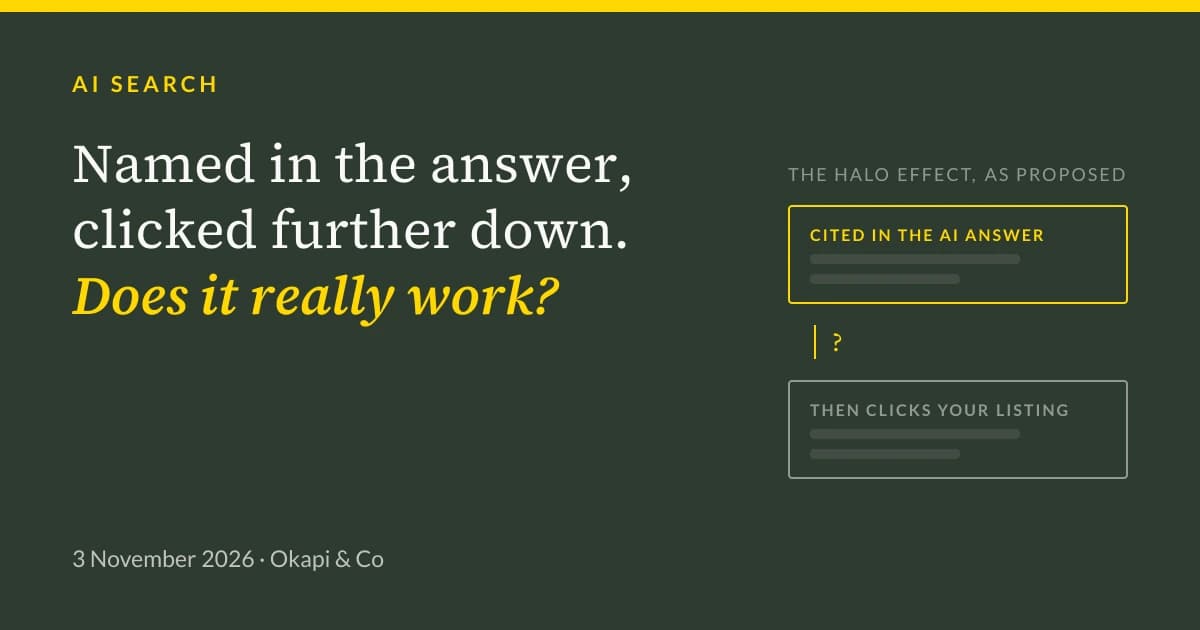
A customer sees your business named in an AI answer, ignores the citation, and clicks your ordinary Google listing instead. That possible knock-on benefit has a name, and one small test behind it. Here is what the evidence says, what it does not, and how to start measuring the wider picture yourself.
A customer sees your business mentioned in an AI answer. They do not click the citation. Instead, they scroll down and click your ordinary Google listing.
If that happens, the visit may look like a regular organic click. The AI answer may still have played a part in the decision. That possible knock-on benefit is known as the AI search halo effect.
It is an interesting idea. It is not yet a proven reason to expect more traffic. Here is what the evidence says, what it does not say, and how to start measuring the wider picture for your business.
What is the AI search halo effect?
The proposed halo effect is the idea that a mention or citation in an AI-generated search answer could make someone more likely to notice, trust or click the same business elsewhere in the search results.
Imagine a Dorset heating company appearing as a source in an AI Overview about heat pump maintenance. A homeowner sees its name there, then clicks the company's normal search listing further down the page. The visit arrives through organic search, even though the AI answer may have influenced the choice.
That is an illustration, not a measured customer journey. People might click for many other reasons, including the title, position, familiarity with the business or a competitor's absence.
What did the recent test find?
In October 2026, SEO consultant Cyrus Shepard shared a small test involving a website that opted out of Google's AI search features. Search Engine Land reported that AI impressions fell to zero and ordinary organic clicks also declined. Shepard estimated an AI click-through rate of 0.9% from changes in overall clicks before and after the opt-out.
The important word is small. The report did not disclose the site's traffic volume, the dates, the size of the organic decline or the precise opt-out method. Without those details, we cannot tell whether removing AI visibility caused the drop, or whether the result would apply to another website.
Search results change all the time. Seasonality, rankings, competitors, website edits and demand can all affect clicks. A before-and-after chart is a useful prompt for investigation, not a verdict.
This is the same habit we keep coming back to in myth busting the AISEO and GEO hype: one chart from one site is a reason to look closer, not a finding to build a budget on.
Why referral traffic is only part of the story
A direct referral tells you when someone clicks a link and the visit is recorded as coming from a particular source. That is useful, but it cannot show every earlier influence on a buyer's decision.
Someone may see your name in an AI answer, search for your business later, ask a colleague about you and then complete an enquiry. None of those steps on its own proves what influenced the sale. Together, they are a reminder to look beyond a single traffic report.
We would still track visits and conversions. We would also look at the questions customers ask, the visibility of priority pages and whether more people are searching for the brand. A rise in brand searches is a signal to investigate, not proof of an AI halo.
There is a second trap worth knowing about before you read too much into any dashboard. Some tracking tools cannot reliably match a search result to the page that appeared, so an apparent disappearance can be a gap in the data rather than a change in your visibility.
A practical way to investigate
You do not need an expensive dashboard to begin. Pick a small group of important topics and keep a consistent record for several weeks.
- Choose the questions. List 10 to 20 searches that real customers ask before buying. Include service, comparison and local questions where relevant. Our prompt audit guide sets out how to build and keep that list.
- Record what appears. For each search, note the date, location, whether an AI Overview appeared, whether your business was cited and which ordinary listing was shown. Screenshots help, but individual results can vary.
- Save a baseline. Export relevant Google Search Console impressions, clicks and click-through rates for the queries and pages. Record rankings if you have a reliable tool, plus enquiries and conversions from your analytics or CRM.
- Keep notes on changes. Add the dates of major website edits, campaigns, ranking changes, seasonal events and any AI search controls. They may explain movement in the numbers.
- Compare over time. Review the same questions and metrics each week. Look for patterns, not a single screenshot or one good day.
- Ask customers. Add an optional, open question to your enquiry process: "Where did you first hear about us?" Their answers will not capture every influence, but they can add useful context.
If you want to test a change, use comparable page groups and a clear measurement period where practical. A comparison group can reduce some confusion, but it does not remove every difference between pages or audiences. Avoid switching off AI visibility on a commercially important page just to chase an unproven effect. Understand Google's controls and the potential consequences before making any opt-out decision.
What should a business do now?
Keep doing the work that helps people find and trust you: answer genuine customer questions, make your expertise clear, keep business details consistent and publish useful evidence. That is the ordinary work of getting mentioned in AI answers, and it is the same work whether or not the halo turns out to be real.
Check whether your pages are accessible to search engines, and measure enquiries as well as visibility. If you are not sure where you stand, our walkthrough on how to check if your business is invisible to AI search is the place to start.
The halo effect is a hypothesis worth watching. It is not a guarantee that an AI citation will lift organic traffic, and it does not mean every business should make the same choice about AI features. It is also not a reason to drop the search work you already do, which is the argument we made in you are already doing SEO, so why do you need GEO as well.
Tagged: Guide, News, AI Overviews, AI visibility, Search Console.

Jim Chetwode
Founder, Okapi & Co · Shaftesbury, Dorset
Thirty years in digital marketing, now spent on how businesses get found in Google and cited by AI assistants. Chairman of the Shaftesbury and District Chamber of Commerce, Dorset Ambassador, and the person who runs the AI workshops.