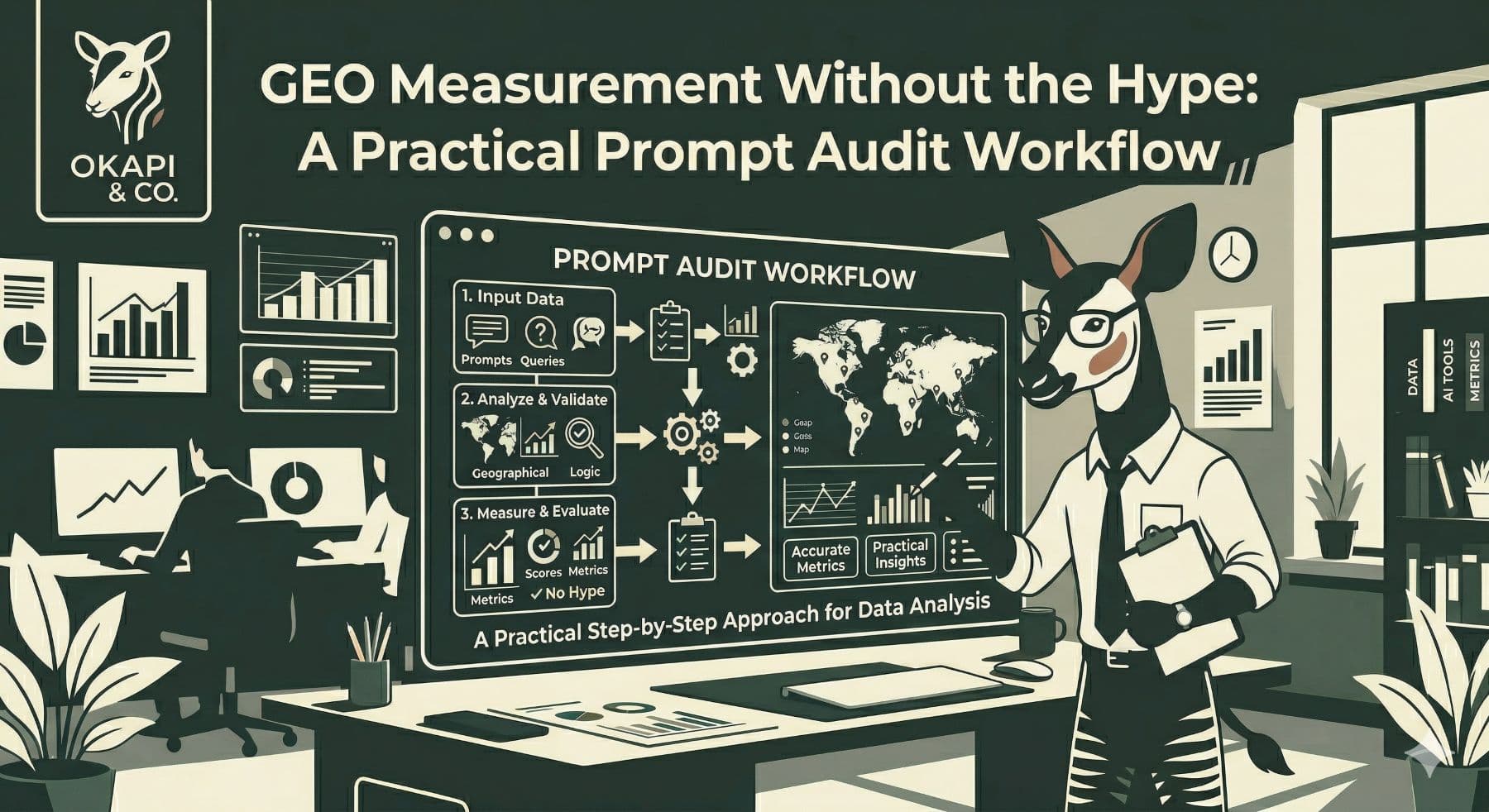
GEO Measurement Without the Hype: A Practical Prompt Audit Workflow
By Jim Chetwode · 27 March 2026 · 8 min
Stop guessing about AI visibility. Learn a simple, repeatable prompt audit workflow to track citations, brand mentions, and answer drift across AI engines.
If you're trying to measure GEO results, you've probably noticed something: the numbers don't always match, the tools don't agree, and nobody can tell you exactly why your content was or wasn't cited in an AI answer.
That's not a bug. It's the nature of generative systems right now.
But that doesn't mean you're stuck guessing. This post shows you a simple, repeatable workflow that works despite the uncertainty.
The Measurement Problem in GEO
Traditional SEO measurement is straightforward: rank for a keyword, track your position, measure clicks. AI systems break this model.
Here's why:
- Non-deterministic outputs. Run the same prompt in ChatGPT twice and you might get different citations, different answer structure, or a completely different answer. This is by design.
- No standard ranking metric. There's no "position 1" in an AI answer. Your content might be the primary source, one of many, or mentioned without a link.
- Tool blindness. Third-party trackers sample prompts and try to extrapolate, but they can't know what individual users actually see.
So how do you measure impact? You stop trying to measure everything, and instead track what actually matters: are we being cited, and how often?
What "Being Cited" Actually Means
In AI answers, citation is the new visibility metric.
Your content might:
- Be the primary source (the AI attributes an answer or stat to you)
- Be one of several sources (mentioned as supporting evidence)
- Be mentioned by name (without a link)
- Appear in a list (of resources or alternatives)
- Not appear at all
Each of these is a different outcome. A prompt audit workflow helps you track all of them.
Building Your Prompt Audit Set
Start simple. Your "prompt set" is a fixed list of prompts you run regularly. It doesn't have to be huge.
Choose 10-20 prompts that represent:
- Awareness stage questions your customers ask (e.g., "What is a heat pump and how does it work?")
- Consideration stage questions (e.g., "Heat pump vs air conditioning: which is better for my home?")
- Decision stage questions (e.g., "How to find a local heat pump installer")
- Your branded searches (e.g., "Best heat pump companies in Dorset", "Acme Heating reviews")
Example set for a plumbing business:
- What should a boiler service include?
- How often do you need a boiler service?
- Boiler service vs central heating maintenance
- Cost of boiler service 2026
- Best local plumber Shaftesbury
- How to find an emergency plumber
- Boiler repair vs replacement
- What to look for when choosing a plumber
- My boiler is leaking water
- Central heating not heating
Keep the same set for at least 4-6 weeks so you can spot trends.
Running the Audit: Where and How
You don't need to run prompts everywhere. Start with 2-3 systems:
1. Google AI Overviews (where available)
Search Google for your prompt. If an AI Overview appears, screenshot it and note:
- Does your content appear in the sources list?
- Is your brand mentioned in the answer text?
- Which competitors are cited?
- Is the answer stable (run it again tomorrow, does it change?)?
2. ChatGPT or Perplexity
You can run the same prompts here. ChatGPT shows sources when you ask "where did this come from?" Perplexity shows citations inline.
Note the same things: your brand, your competitors, source stability.
3. One industry-specific AI tool (optional)
If your industry has a specialised tool (legal research, medical info, property search), use that too.
What to Record
You don't need to log everything. Use a simple spreadsheet or Notion table with these columns:
- Date
- Prompt (the exact question)
- Engine (Google, ChatGPT, Perplexity)
- Your brand mentioned? (Yes / No / Position in answer)
- Your content cited? (Yes / No / Which page?)
- Competitors mentioned (list 3 top ones)
- New findings (anything interesting about how the answer changed)
Run it once a week. Spend 20 minutes per engine. That's it.
Interpreting the Data (Without Overclaiming)
Here's what you're looking for:
Good signs
- Your brand appears in more prompts week-on-week
- You're cited before competitors on your core topics
- The answer structure favours your expertise (e.g., a local search puts local sources first)
Warning signs
- Competitors are cited more consistently than you
- Your content appears in only one or two engines
- When you appear, you're always listed as "also consider" rather than primary
Noise (ignore)
- Occasional variations in which sources are cited (this is normal)
- Being absent from a single prompt (some queries won't have your type of content)
- Different answer phrasing on re-run (expected)
The point is: you're looking for trends over 4-6 weeks, not single-prompt data points.
Turning Findings into Action
If your audit shows gaps, what do you do?
If you're not being cited at all on a core topic:
- Check that the content exists and answers the prompt clearly
- Make sure the answer is extractable (short paragraphs, lists, tables)
- Ensure your credentials and business details are visible (About page, team bios, schema markup)
- Refresh the page (add recent data, update examples, add an "updated" date)
If competitors are cited more:
- Read what they wrote and how they structured the answer
- Do you cover the same ground? If not, add that content
- Is theirs more recent? Refresh yours
- Do they have stronger credentials? Strengthen your About/Author/Entity schema
If you're cited but rarely linked:
- Improve your entity markup so the AI knows your business name, location, and expertise
- Add unique, original data the AI can attribute to you (test results, local data, original research)
- Make sure your business name is consistent across your site and directories
Common Questions
"How long before I see results?"
Probably 2-4 weeks. AI systems don't update in real time. Your content might take time to be indexed and evaluated by the AI model.
"Do I need to change my SEO strategy?"
No. The fundamentals still matter: crawlability, helpfulness, clear structure, original value. You're not optimising for AI in a special way. You're optimising because of AI.
"What if I'm in a niche where no AI Overviews appear?"
Focus on ChatGPT and Perplexity instead. These systems don't require Google to appear. Run the same audit there.
"Is this guaranteed to increase visibility?"
No. There are no guarantees in AI systems right now. But tracking your actual position is better than following a checklist and hoping. Data beats assumptions.
Next Steps
- Build your prompt set this week (10-20 questions your customers actually ask)
- Run the first audit on Friday (pick Google and one other engine)
- Record your baseline
- Run again the same day next week
- Compare and adjust your content based on what you find
That's the workflow. It's not magic, but it's honest, repeatable, and it works.
Tagged: Guide, Resource.

Jim Chetwode
Founder, Okapi & Co · Shaftesbury, Dorset
Thirty years in digital marketing, now spent on how businesses get found in Google and cited by AI assistants. Chairman of the Shaftesbury and District Chamber of Commerce, Dorset Ambassador, and the person who runs the AI workshops.