
Thinking of Leaving WordPress? The 10 Questions Business Owners Ask Us First
By Jim Chetwode · 16 November 2026 · 7 min read
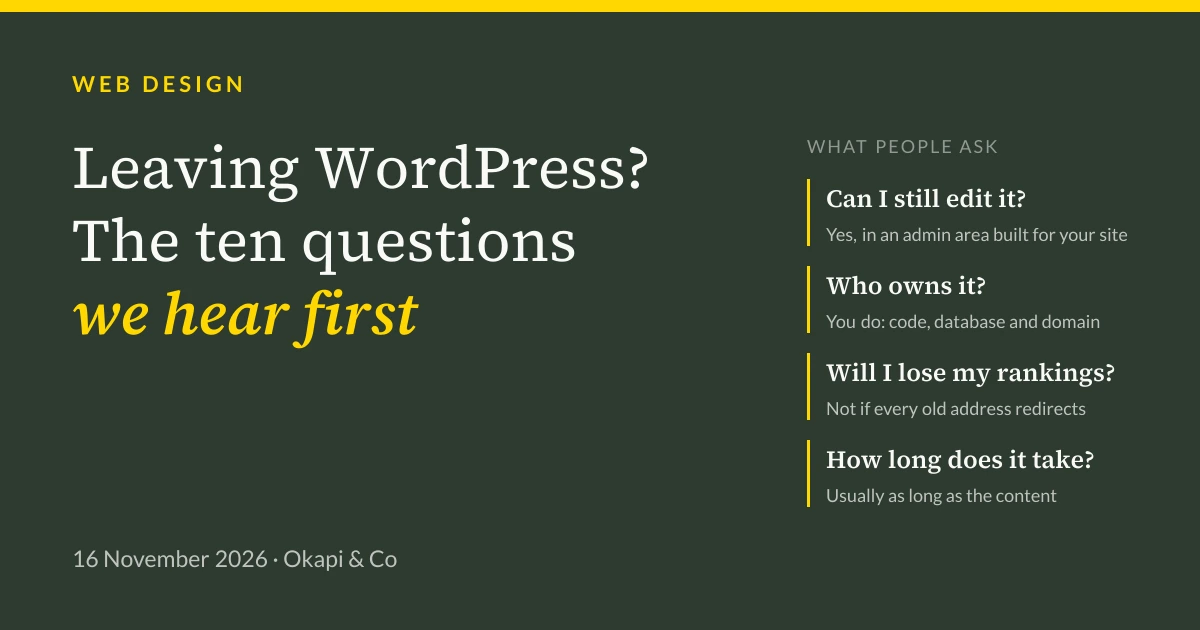
Thinking of moving away from WordPress, Squarespace or a website builder? Honest answers to the ten questions business owners ask us most, from editing and ownership to rankings, running costs and timescales.
Most of my week is spent talking to business owners about their websites. Health start-ups, trades businesses, consultancies, community groups, hospitality brands. Different sectors, but the same questions come up again and again.
So I went back through my recent meeting notes and pulled out what people actually ask when they are thinking about leaving WordPress (or Squarespace, or a website builder) for a site built with Claude. Here are the honest answers.
Why people want to move
Before the questions, it is worth saying what people are really after. When you strip it back, it comes down to five things.
- They want to change the words themselves without breaking anything. Not a back end full of menus for features they do not use. Just a simple place to update text, add an event or publish a post.
- They want to own it. Many have been burned by a previous supplier who held the logins, or a builder that made it hard to leave.
- They are tired of the update treadmill. Plugin updates, theme updates, security alerts. A recent PHP vulnerability had several of our clients asking whether their WordPress sites were exposed.
- They want the site to do something specific. A savings calculator, a quote estimator, an events listing, a guide people request before downloading. Things a generic plugin does badly or not at all.
- They want running costs they can understand. One hosting bill, not a pile of plugin subscriptions renewing at different times of year.
Questions, answered: the ten we hear most
Can I still edit it myself?
Yes, and this is usually the first question. You get an admin area where you can change text, swap images, add events and publish blog posts. It is built around your site, so there is nothing in it you do not need.
Bigger changes to layout or structure are where we come in. That split works well: you keep control of day-to-day content, and you are not left trying to rearrange a page at 10pm before a launch.
Who owns it, and can I leave?
You own it. The code lives in your own GitHub account, the database in your own account, and the domain should be registered in your business's name. If you want to move to another developer, you take everything with you.
That is not true of every option. Some website builders make it very hard to take your site with you when you go. Always ask that question before you sign up to anything.
Will I lose my Google rankings if I move?
Not if the move is done properly. The important part is keeping your existing page addresses, or redirecting each old address to its new home, so Google and anyone with a bookmark ends up in the right place. Then we resubmit the sitemap and watch Search Console.
In our experience a short wobble after a move is normal and settles if the redirects are right. Where it goes wrong is when a site is rebuilt and the old pages simply disappear.
Is it secure, accessible and GDPR friendly?
No website is free of security problems, whatever it is built on. Recently a vulnerability in PHP, the language WordPress runs on, had several of our clients asking whether their sites were exposed. Sites built the way we build them have their own risks too. They rely on code libraries (developers call them dependencies), and those get security fixes all the time.
The answer is to keep on top of it. We use an automated agent to scan our sites for vulnerable dependencies every day, so fixes are spotted and applied quickly. It is more reliable than relying on a person remembering to check.
Security is not only about the platform, though. Every site we build includes a privacy notice, cookie consent, a clear opt-in on any mailing list sign-up, and forms that handle personal details carefully. You should also check whether your business needs to pay the ICO data protection fee.
If you handle sensitive information, such as health details, keep it in a dedicated secure system rather than collecting it through website forms. The website can take bookings and payments and link to that system.
We build to WCAG 2.2 AA accessibility as standard. Several clients have told us funders will not support an inaccessible website, and it is the right thing to do anyway.
What will it cost, and what are the monthly bills?
As a guide, most of our website builds come in between £2,500 and £4,000 plus VAT, depending on how complex the site is and what it needs to do.
Then there are the monthly running costs. At the time of writing, Vercel hosting is $20 a month. Services such as GitHub (where the code lives), Neon (the database) and Resend (which sends your website's emails) all have free tiers.
Even so, I suggest allowing around $50 a month for a properly secure setup. My rule of thumb is that paid plans tend to come with stronger security and support than free ones, and security matters more than anything. Prices change, so we set out every line before you commit, and you pay the suppliers directly so there are no hidden mark-ups.
Should you build it, or can you teach me?
Either. Some clients want it done for them. Others want to sit alongside us and build it together, then look after it themselves, and our Build Your Website with Claude Code workshop is a 3-hour afternoon session of exactly that. A popular middle route is that we build the first version, you learn by updating it, and you call us for the bigger changes.
What happens to my domain name and email?
They usually stay where they are. We point your domain at the new site and leave your email alone, or help you move to a better setup if you need one.
The slowest part of many launches is not the website at all. It is finding the login for the account where the domain was registered years ago. Do one thing today: check the domain is in your business's name, and that you, not a former supplier, can log in.
Can it do the specific thing I need?
Usually, yes. Because the site is built for the job, features can be made to fit how your business works. Recent projects have included:
- a calculator where a customer enters a number and sees projected savings
- an events page where the team adds events and links to their ticketing provider
- a request form that captures details before someone is sent a guide
- a mailing list and simple contact records kept in the admin area
If an existing tool already does the job well, such as a specialist quote calculator for your industry, we embed it rather than rebuild it.
Will a new website bring me more customers?
Not on its own, and anyone who promises that is overselling. New sites take time to rank in Google, and the same goes for being mentioned in AI answers from tools like ChatGPT or Gemini.
A website's job is to turn visitors into enquiries, with a clear message and one obvious next step. Getting people there is the work around it: a complete Google Business Profile, a steady stream of reviews, short videos on YouTube, consistent details across every directory, and partners who refer you. We help with all of that through our SEO and AI search work, and it matters more than the platform. If you want the local side in more detail, start with how to get found in your area.
How long does it take, and what do you need from me?
The build itself is often quicker than people expect. The wait is almost always content: the words, the photos, the logo files and the team bios. If you can gather those first, things move fast.
If you have a deadline, such as a conference or a funding bid, we can put up a branded holding page with a working contact form first and build the full site behind it.
When WordPress is still the right choice
I am not anti-WordPress. I have built WordPress sites for twenty years and still look after several. If your needs are standard, your team already knows it well, or you rely on a specific plugin that does exactly what you need, staying put can be the sensible choice.
A move makes most sense when you are paying for features you never use, struggling to make simple changes, worried about updates, or need the site to do something your current setup cannot.

Jim Chetwode
Founder, Okapi & Co · Shaftesbury, Dorset
Thirty years in digital marketing, now spent on how businesses get found in Google and cited by AI assistants. Chairman of the Shaftesbury and District Chamber of Commerce, Dorset Ambassador, and the person who runs the AI workshops.