
SEO in an AI World: What Has Actually Changed, and What Has Not
By Jim Chetwode · 9 November 2026 · 8 min read
Search now answers questions as well as listing links, and a lot of what is sold as AI SEO is guesswork with a price tag. Here is what the evidence actually supports, what has not changed at all, and the three things worth doing about it.
If you run a business, you have probably been told that SEO is dead, that you need something called GEO instead, and that it is urgent.
Two of those three are wrong.
Search has genuinely changed. Google now answers a lot of questions on the page, ChatGPT is a place people ask for recommendations, and some of the traffic you used to get is not coming back. That part is real. What is not real is the idea that this requires a separate discipline, a new monthly retainer and a set of techniques nobody can show you the evidence for.
This is the plain version. What has changed, what has not, and what is worth your time.
The short version
- Being found still comes first. Nothing appears in an AI answer that search engines cannot reach, read and trust. The groundwork is the same groundwork.
- The click is no longer the only outcome. People now see your name without visiting your site. That is worth something, but less than the people selling it imply, and it is hard to measure.
- Most of what is sold as AI SEO is ordinary good practice with a new label. The parts that are genuinely new are mostly about measurement, not about tricks.
What has actually changed
Three things, and they are worth separating because they affect you differently.
Answers now sit above the links. When someone searches a question, Google often answers it. If your page is the source, your name may appear. If the answer is complete, the person may not click anything at all. This is the real shift, and it hits informational content hardest. A page answering "how often should a heat pump be serviced" is more exposed than a page about booking a heat pump service in Shaftesbury.
People ask assistants for recommendations. ChatGPT and similar tools get asked who to use, not just what something is. Whether your business comes up depends largely on whether it is clearly understood: a consistent name, a clear description of what you do and who you serve, and some evidence that you exist and are any good.
Advertising is arriving in those answers. On 28 October 2026 Google announced that ads in AI Mode were expanding to ten more countries, with the UK planned for the final quarter of 2026. That was a plan rather than confirmation that every UK advertiser has access, so treat it as something to watch rather than something to budget for yet.
What has not changed at all
This is the part that gets lost.
Google's own documentation is blunt about it: there are no additional requirements to appear in AI Overviews or AI Mode. The same fundamentals apply. A site that loads properly, can be crawled, says clearly what it does, answers real customer questions and has some genuine standing is the site that gets included. A site that does none of that does not get rescued by a GEO package.
So the work is still this: a technically sound website, pages that answer what customers actually ask, accurate and consistent business details, and real evidence of your expertise. If an agency tells you AI search requires something fundamentally different, ask them to show you where. The primary source says otherwise.
The thing most businesses get wrong about measurement
The instinct is to ask "how much traffic is AI sending me?" It is the wrong first question, because the honest answer is usually "less than you would hope, and you cannot see most of it anyway".
Someone might see your name in an AI answer, not click, search for your business by name two days later, and enquire. That arrives in your reports as a brand search or a direct visit. The AI answer influenced it and left no trace.
This is why we talk about recognition alongside visits. Are more people searching for you by name? Are enquiries mentioning things they could only have read on your site? Is your business described accurately when you ask an assistant about your sector? None of these is proof on its own. Together they tell you more than a traffic chart does.
There is also a less glamorous problem. A study published at the end of October 2026 found that between 54.8% and 84.7% of Google organic results, depending on which data provider was used, came back without a usable destination address. That can make a tracking tool report your page as absent when it is sitting there on the page. Three of the five providers had largely fixed it within days. We wrote about how to check whether your tracker is affected, because a dashboard going red is a reason to investigate, not a reason to panic or to change strategy.
How much of this is actually proven
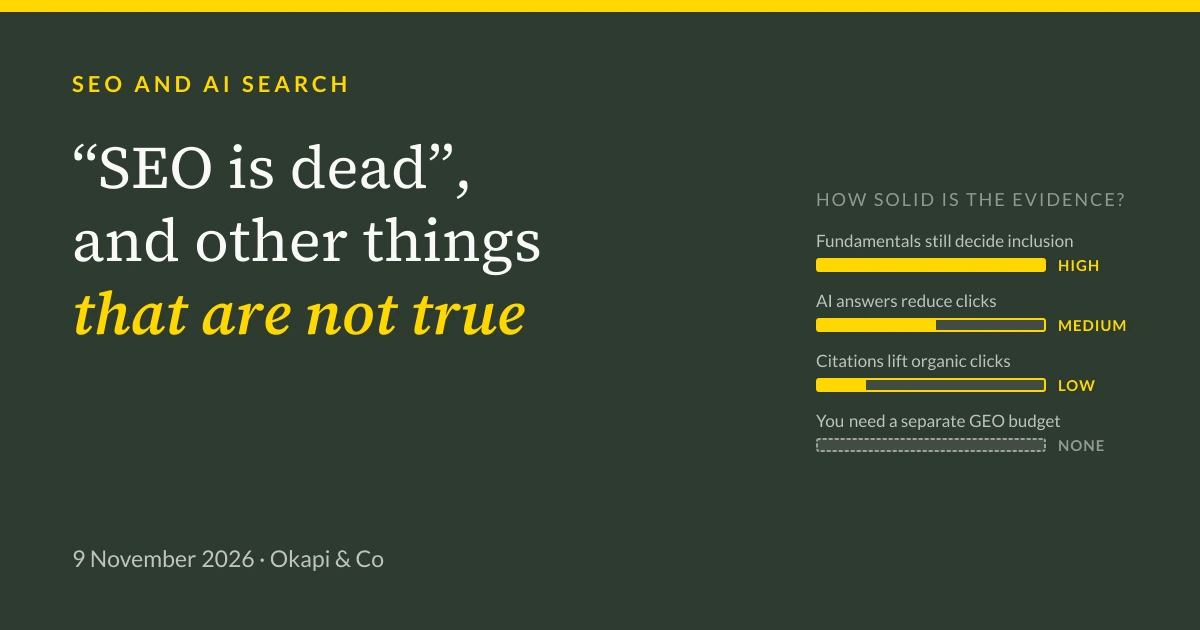
We think this is the most useful table on the page, because almost nobody publishing about AI search shows you how solid their evidence is.
| Claim you will hear | What the evidence actually is | How much weight to give it |
|---|---|---|
| The fundamentals still decide inclusion | Google's own published documentation on AI features | High. Primary source, stated repeatedly |
| AI answers reduce clicks to websites | Several industry datasets, plus a small October 2026 opt-out test that estimated a click-through rate of about 0.9% from AI features | Medium. The direction is consistent, the size varies a lot by sector and query |
| Appearing in AI answers lifts your ordinary organic clicks | One small test, with the site's traffic volume, dates and opt-out method undisclosed | Low. A hypothesis worth watching, not a reason to spend money |
| ChatGPT traffic converts worse than Google traffic | A working paper covering nearly 1,900 websites. In the US paid comparison, $0.89 revenue per ChatGPT ad visit against $2.45 for a Google Search ad, and conversion rates of 0.37% against 1.17% | Medium. Observational, a smaller paid sub-sample, and US data. Not a forecast for your business |
| You need a separate GEO strategy and budget | Vendor marketing | None. Ask for the evidence and watch what happens |
If you want the longer argument about what can and cannot be promised here, we set it out in getting mentioned in AI answers.
Three things worth doing
Not eight. Three, and you can do all of them yourself.
1. Check you can be described correctly. Twenty minutes. Ask ChatGPT, and Google's AI Mode if you have it, what your business does and who it serves. Then ask it to recommend a business like yours in your town. Write down exactly what comes back. If the description is wrong, vague or missing, that is your problem to fix, and it is usually a website problem: an unclear About page, no named people, services described in language nobody searches for, or business details that disagree with your Google Business Profile.
2. Write down ten real customer questions, then check you answer them. An hour. Not keywords. The actual sentences people say on the phone before they buy. Then look at your site and see whether each one has a clear answer somewhere obvious. Most businesses find three or four that are answered nowhere, and those are the most valuable pages they can write this quarter.
3. Take a baseline you can compare against. Thirty minutes. Export your Search Console figures for your most important pages and queries. Note how many enquiries you had last month and where they said they came from. Put the same exercise in the diary for three months' time. Without a baseline, every claim anyone makes about your AI visibility, including ours, is unfalsifiable.
If you only do one, do the first. It takes twenty minutes and it tells you whether you have a real problem or an imaginary one.
What we are not recommending yet
Buying an AI visibility tracking subscription before you have done the three things above. The data quality issues are real, the numbers move for reasons that have nothing to do with you, and you will be paying to watch a chart you cannot act on.
Turning off Google's AI features on commercially important pages to see what happens. The one test that makes this look informative was small and did not disclose its method. The downside is losing visibility on pages that earn you money.
Rewriting your whole site to be more quotable. Clear structure and direct answers genuinely help. Rewriting good pages that already convert, in pursuit of a citation, is a bad trade.
The honest summary
Search is becoming a place where your business gets described, not only listed. The work that earns a good description is the same work that earned a good ranking: be findable, be clear, be specific, be real.
What is new is that measurement got harder and the selling got louder. Our advice is to hold your nerve, do the fundamentals properly, and grade the evidence before you spend on anything with AI in the name.
Frequently asked questions
Is SEO dead?
No. Search engines still decide what gets included in AI answers, and the criteria have not meaningfully changed. What has changed is that inclusion no longer guarantees a visit, so the fundamentals matter as much as ever while the reporting has become harder to read.
What is the difference between SEO and GEO?
SEO is the work that makes your site findable and trustworthy to search engines. GEO, or generative engine optimisation, is a term for making your content easy for AI systems to quote accurately. In practice the overlap is almost total. Google states that no additional requirements exist to appear in its AI features, so treat anyone selling GEO as a wholly separate discipline with caution.
Will appearing in AI answers bring me more traffic?
Not reliably. Some people will see your name and not click at all. The idea that an AI citation lifts your ordinary organic clicks, sometimes called the halo effect, rests on one small test and is not yet proven. Treat a mention as useful recognition rather than as a traffic channel.
How do I know if my business appears in AI answers?
Ask the assistants directly, using the questions your customers actually ask, and keep a dated record of what comes back. Do this consistently over several weeks rather than once, because answers vary by person, place and day. Check your Search Console figures for AI feature impressions alongside it.
Should I pay for an AI visibility tool?
Only after you have a baseline and a specific question you want it to answer. Tool data quality varies, reported drops are sometimes artefacts rather than real changes, and a subscription will not tell you anything useful if you are not already measuring enquiries.
Where to go next
If you want this done properly rather than guessed at, our SEO and AI search work starts with finding out how your business is currently described and where the real gaps are. If you would rather learn to do it yourself, that is what our workshops are for.
Or book a visibility call. Twenty minutes, no pitch, and we will tell you straight whether this is worth your money yet.

Jim Chetwode
Founder, Okapi & Co · Shaftesbury, Dorset
Thirty years in digital marketing, now spent on how businesses get found in Google and cited by AI assistants. Chairman of the Shaftesbury and District Chamber of Commerce, Dorset Ambassador, and the person who runs the AI workshops.